
Supreme Court Holds that Trademark Statute Applies Only to Domestic Conduct

Last week, in Abitron Austria GmbH v. Hetronic International, Inc., the Supreme Court held that the federal trademark statute—known as the Lanham Act—applies only to domestic conduct infringing U.S. trademarks. The case involved foreign companies that put U.S.-protected trademarks on products that they made in Europe, most of which were sold to customers abroad, but…
Continue ReadingSupreme Court Approves Using Civil RICO to Help Enforce Arbitral Awards

Last week, the Supreme Court held in Yegiazaryan v. Smagin that civil RICO can be used to help enforce foreign arbitral awards. Specifically, the Court held that concealing assets to avoid paying a U.S. judgment that confirmed a foreign arbitral award could satisfy civil RICO’s “domestic injury” requirement, allowing the award-creditor to pursue a claim…
Continue ReadingThrowback Thursday: Hartford Fire Insurance Co. v. California
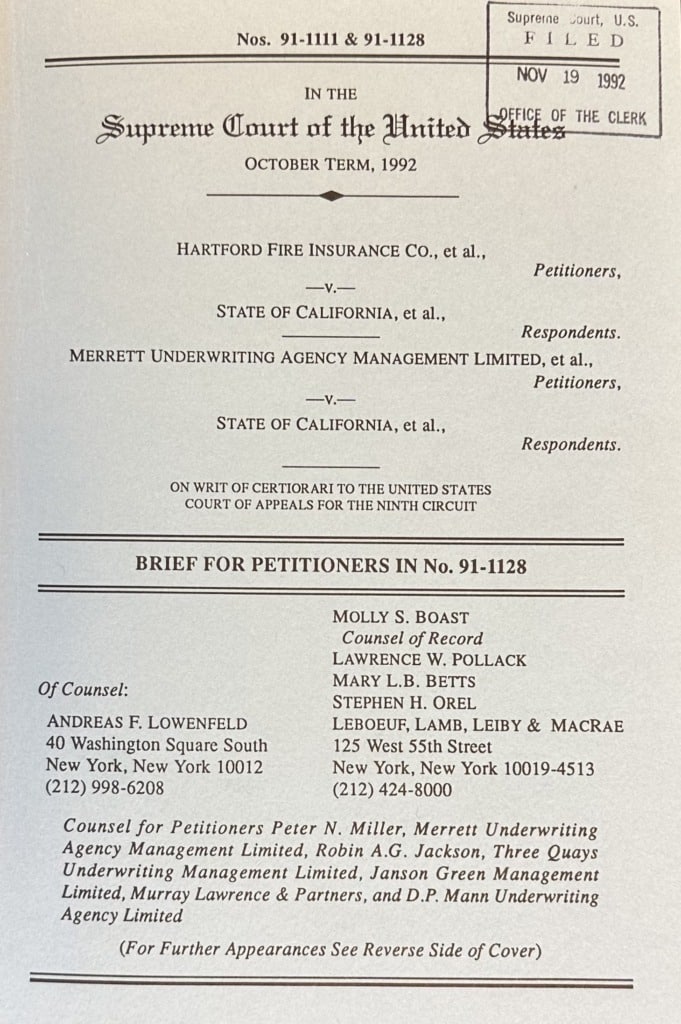
Thirty years ago next week, the Supreme Court addressed the extraterritorial reach of U.S. antitrust laws in Hartford Fire Insurance Co. v. California. The Court reiterated that the Sherman Act applies to anticompetitive conduct abroad that causes substantial intended effects in the United States, but it divided sharply over the role of “international comity.” Writing…
Continue ReadingSupreme Court Finds Tech Companies Not Liable for Terrorism

Last week, the Supreme Court decided two cases in which plaintiffs alleged that social media companies aided and abetted international terrorism. In the first case, Twitter, Inc. v. Taamneh, the Justices unanimous interpreted the Antiterrorism Act’s (ATA) provision on aiding and abetting to require conscious and culpable participation. Plaintiffs’ allegations that ISIS used defendants’ social…
Continue ReadingDear Justice Gorsuch: There’s No Reason to Worry About the Remand in Halkbank

In Turkiye Halk Bankasi A.S. v. United States (Halkbank), the Supreme Court held that the Foreign Sovereign Immunities Act (FSIA) does not apply to criminal proceedings. The Court remanded the case to the Second Circuit to reconsider Halkbank’s claim of common law immunity. Justice Gorsuch, joined by Justice Alito, wrote a partial dissent. He would…
Continue ReadingSupreme Court Oral Argument in Extraterritorial RICO Case Marked by Confusion
The Supreme Court heard oral argument last week in Yegiazaryan v. Smagin and CMB Monaco v. Smagin, two cases testing when civil RICO can be used to help enforce a foreign arbitration award. Because I have described the facts in a previous post, I will be brief here. Smagin and Yegiazaryan are Russian citizens who…
Continue ReadingOpen Questions after Halkbank

The Supreme Court held this week in Türkiye Halk Bankasi, A.S. v. United States that the Foreign Sovereign Immunities Act (FSIA) does not apply to criminal prosecutions. That holding was a blow to Halkbank—a foreign state-owned enterprise under indictment—which had argued that the FSIA provided it with immunity. But the case is not over. The…
Continue ReadingThrowback Thursday: Kiobel v. Royal Dutch Petroleum Co.
Ten years ago this week, the U.S. Supreme Court handed down its decision in Kiobel v. Royal Dutch Petroleum Co., applying the presumption against extraterritoriality to the implied cause of action for human rights violations under the Alien Tort Statute (ATS). In Kiobel, the Court began to whittle down the cause of action it had…
Continue ReadingPreview of Supreme Court Argument in Civil RICO Extraterritoriality Case

On April 25, the U.S. Supreme Court will hear oral argument in Yegiazaryan v. Smagin and CMB Monaco v. Smagin, which ask how RICO’s private right of action applies to intangible property, in this case a California judgment confirming a foreign arbitral award. The cases have important implications not just for civil RICO but also for international arbitration….
Continue ReadingAbitron: Media Coverage Round-Up

On March 21, the Supreme Court heard oral arguments in Abitron Austria GmbH v. Hetronic International, Inc., a case on review from the Tenth Circuit raising the geographic reach of federal law. The respondent, an Oklahoma-based electronics manufacturing company, brought a trademark infringement claim under the Lanham Act against the petitioner, a group of German…
Continue Reading