
Transnational Litigation at the Supreme Court, October Term 2025

Today is the first day of the Supreme Court’s October Term. This post briefly discusses transnational litigation cases in which the Court has already granted cert, as well as others that are in the pipeline and could be decided this Term. Cases in which the Court Has Granted Cert So far, the Supreme Court has…
Continue ReadingFuld’s Implications for the FSIA (and Other Federal Statutes)

In Fuld v. PLO, the U.S. Supreme Court held that “the Fifth Amendment does not impose the same jurisdictional limitations as the Fourteenth.” This means that Congress may authorize federal courts to exercise personal jurisdiction over defendants that state courts may not constitutionally reach. In Fuld, the Court upheld the constitutionality of the Promoting Security…
Continue ReadingCVSG in Chabad v. Russian Federation: Another Question of Foreign State Immunity

On June 2, 2025, the Supreme Court called for the views of the Solicitor General (“CVSG”) in Chabad v. Russian Federation. In Chabad’s petition for certiorari, the question presented is whether the Foreign Sovereign Immunities Act (FSIA)’s expropriation exception applies to a foreign state if the expropriated property—or property exchanged for it— is located outside…
Continue ReadingUsing TLB to Teach International Business Transactions
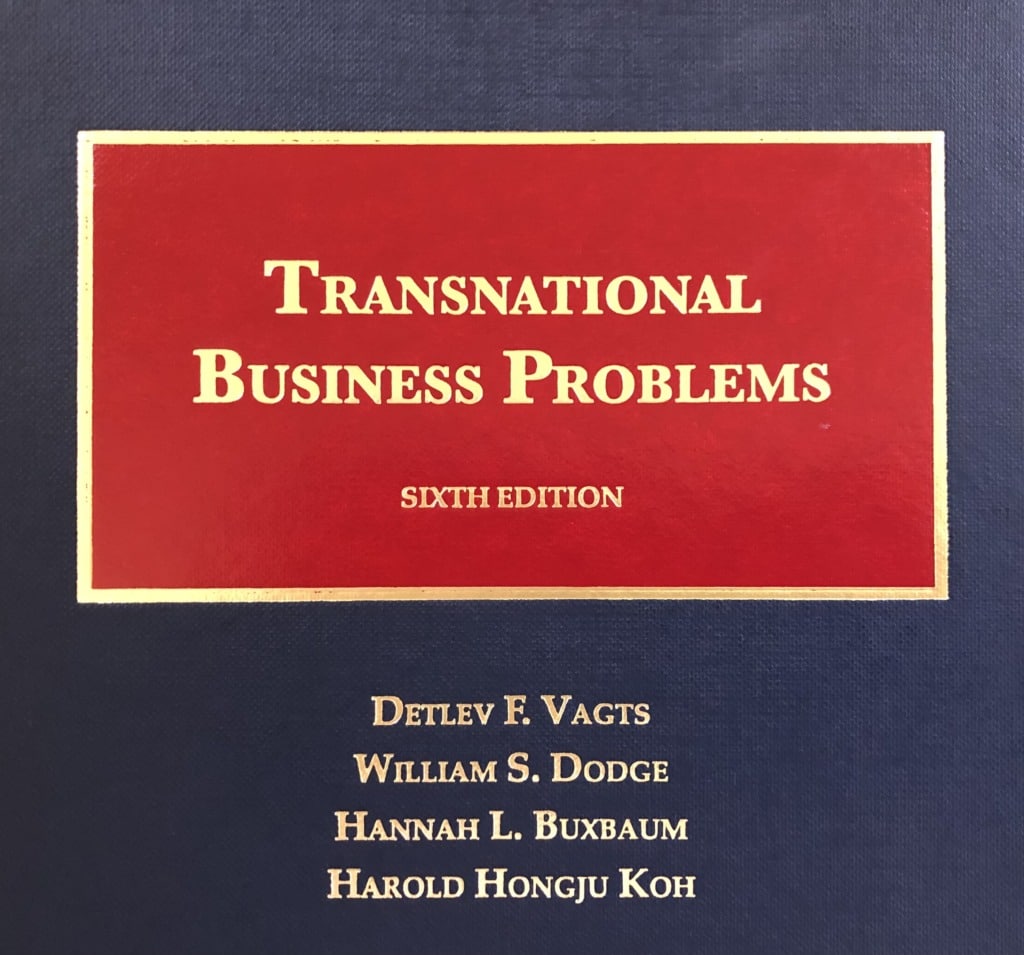
As the fall semester gets underway, we are updating our posts on using resources on TLB to teach various classes. This post discusses International Business Transactions (IBT). Although TLB focuses on litigation and IBT focuses on transactions, there is a great deal of overlap. The most obvious examples are contractual clauses that plan for dispute resolution,…
Continue ReadingThrowback Thursday: Banco Nacional de Cuba v. Sabbatino

Sixty years ago, on March 23, 1964, the U.S. Supreme Court handed down its decision in Banco Nacional de Cuba v. Sabbatino. By a vote of 8-1, the Court held that the act of state doctrine prevented U.S. courts from questioning the validity of Cuba’s expropriations of property owned by U.S. nationals, even if the…
Continue ReadingHow to Criticize U.S. Extraterritorial Jurisdiction (Part I)

[This post is based on a lecture delivered at Wuhan University School of Law on October 15, 2023] China has been critical of U.S. extraterritorial jurisdiction. In February, China’s Ministry of Foreign Affairs issued a report entitled “The U.S. Willful Practice of Long-arm Jurisdiction and its Perils.” In the report, the Ministry complained about U.S….
Continue ReadingPersonal Jurisdiction and Extraterritoriality

The U.S. Supreme Court has repeatedly said that Congress has constitutional authority to regulate extraterritorially. “Both parties concede, as they must,” Chief Justice Rehnquist wrote in EEOC v. Arabian American Oil Co. (1991), “that Congress has the authority to enforce its laws beyond the territorial boundaries of the United States.” The presumption against extraterritoriality, which…
Continue ReadingUsing TLB to Teach Foreign Relations Law
This post discusses Foreign Relations Law as part of our series explaining how professors can use resources on TLB to teach various classes. Previous posts have discussed Transnational Litigation, Civil Procedure, International Business Transactions, and Conflict of Laws. Although TLB focuses on litigation, and Foreign Relations Law classes cover many topics that are rarely litigated, there is significant…
Continue ReadingSanctions and Terrorism
We have launched a new topic page on sanctions and terrorism. Sanctions are a critically important and highly controversial tool of foreign policy for many countries, especially the United States. Many sanctions do not result in litigation. Some do, however, and sanctions cases can produce very large judgments, especially in terrorism-related cases. Sanctions litigation also…
Continue ReadingA Baffling Characterization Decision

Characterization plays an important role in a court’s choice-of-law analysis. If an issue is characterized as a “contracts” issue, then the court will apply the choice-of-law rule for contracts to determine the governing law. If an issue is characterized as a “torts” issue, then the court will apply the choice-of-law rule for torts. Because the…
Continue Reading- « Previous
- 1
- 2
- 3
- 4