
Does the TVPRA Apply Extraterritorially? Thoughts on the U.S. Chamber of Commerce Amicus Brief in Doe v. Apple

As the U.S. Supreme Court has repeatedly limited the scope of the implied cause of action under the Alien Tort Statute (ATS), victims of human rights abuses have looked to other U.S. statutes for remedies. One of these is the Trafficking Victims Protection Reauthorization Act (TVPRA), which creates a civil remedy against perpetrators and others…
Continue ReadingHas the Alien Tort Statute Made a Difference?

In a globalized and interconnected world, human rights litigation has, by necessity, become transnational. For decades, the Alien Tort Statute (ATS) was viewed as a beacon of American justice for foreign victims of human rights violations. However, a series of Supreme Court decisions—most recently the paired cases of Nestlé USA, Inc. v. Doe and Cargill,…
Continue ReadingA Primer on Human Rights Litigation
Modern human rights law developed in response to the events of the World War II, although it has earlier precursors. In 1948, the U.N. General Assembly adopted the Universal Declaration of Human Rights, a non-binding declaration. More than seventy human rights treaties followed, including the Genocide Convention, the International Covenant on Civil and Political Rights,…
Continue ReadingNew Bill Would Amend the Alien Tort Statute to Apply Extraterritorially
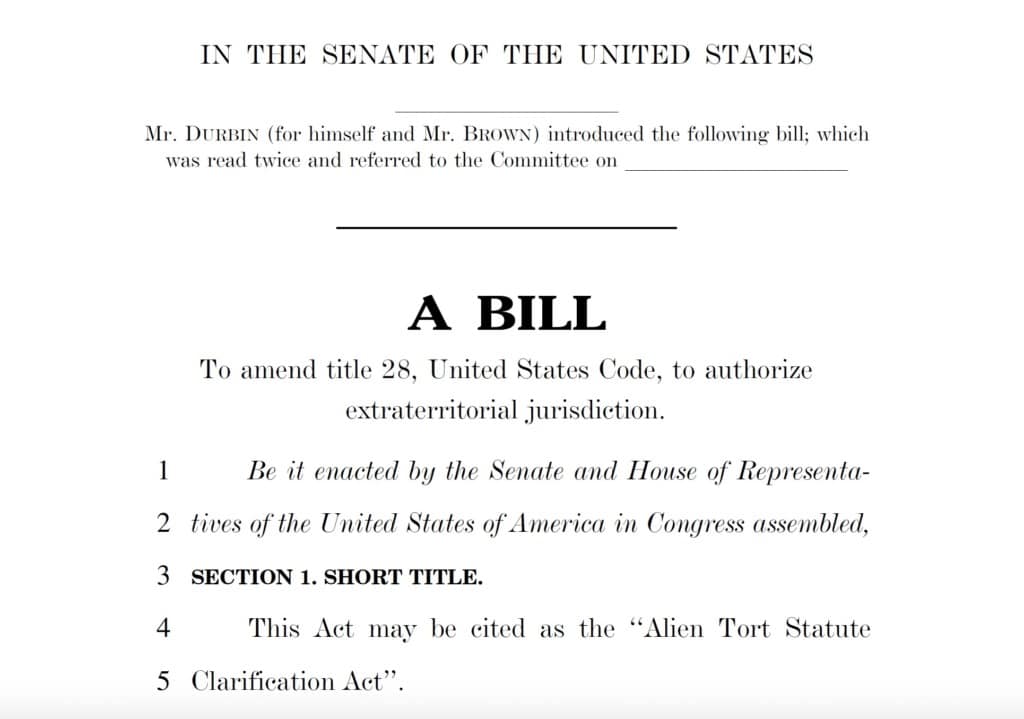
Last week, Senators Dick Durbin and Sherrod Brown introduced a new bill, the Alien Tort Statute Clarification Act (ATSCA), that would amend the Alien Tort Statute (ATS) to apply extraterritorially. Since 1980, plaintiffs have relied on the ATS to bring international human rights claims in federal court against individuals and corporations. But since 2013, the…
Continue Reading- « Previous
- 1
- 2