
Supreme Court Holds in ZF Automotive That Section 1782 Does Not Apply to International Arbitration
The Supreme Court held today that Section 1782 does not apply to international arbitration—neither international commercial arbitration nor investor-state arbitration. Writing for a unanimous Court, Justice Barrett held that only governmental or intergovernmental adjudicative bodies fall within the scope of the provision. Section 1782 authorizes federal district courts to order persons residing or found within…
Continue ReadingDistrict Court Holds that Magnuson-Moss Warranty Act Does Not Apply Extraterritorially

In a recent decision, Eichhorn-Burkhard v. Hill’s Pet Nutrition, Inc., a district court in Kansas (Judge Julie Robinson) held that the Magnuson-Moss Warranty Act (MMWA) does not apply extraterritorially to a U.S. company’s sales of dog food in Europe. The case provides a nice illustration of how U.S. courts apply the presumption against extraterritoriality to…
Continue ReadingThrowback Thursday: International Association of Machinists v. OPEC

In 1978, the International Association of Machinists (IAM), a labor union, sued OPEC and its member countries for violating U.S. antitrust law by operating a cartel. The district court held that OPEC countries were immune from suit under the Foreign Sovereign Immunities Act (FSIA). On appeal the Ninth Circuit affirmed the district court’s dismissal on…
Continue ReadingA Primer on Foreign Official Immunity
Foreign official immunity refers to rules of international and domestic law that shield foreign officials from suit and from criminal prosecution. These rules are related to the rules of foreign sovereign immunity, codified in the U.S. Foreign Sovereign Immunities Act (FSIA), but they differ from those rules in many respects. Rules of foreign official immunity…
Continue ReadingDistrict Court Quashes Substituted Service on Chinese Defendant

In a recent decision, Topstone Communications, Inc. v. Chenyi Xu, a federal court in Texas (Judge Keith Ellison) held that a plaintiff headquartered in Texas must serve defendants based in China by using the Hague Service Convention. The opinion provides a good analysis of how both substituted service on a state official and service by email…
Continue ReadingCourt Holds that ATS Claims for Medical Experimentation Are Not Impermissibly Extraterritorial
In a recent decision, Estate of Alvarez v. The Johns Hopkins University, a federal district court held that claims under the Alien Tort Statute (ATS) based on nonconsensual medical experiments in Guatemala were not impermissibly extraterritorial. Although the district court ultimately granted summary judgment for the defendants on other grounds, the decision is significant because…
Continue ReadingSubstituted Service and the Hague Service Convention
Can state law be used to avoid a federal treaty, even though the Supremacy Clause of the U.S. Constitution makes treaties supreme over state law? The somewhat surprising answer is yes—at least when it comes to the Hague Service Convention and state rules on substituted service. The Hague Service Convention governs transnational service of process…
Continue ReadingSecond Circuit Rejects Act of State Doctrine in Antitrust Case

In a recent decision, Celestin v. Caribbean Air Mail, Inc., the Second Circuit held that the act of state doctrine does not bar U.S. antitrust claims based on the acts of a foreign government. Although the Second Circuit is right, its decision diverges from the decisions of other circuits that have applied the doctrine as…
Continue ReadingNew Bill Would Amend the Alien Tort Statute to Apply Extraterritorially
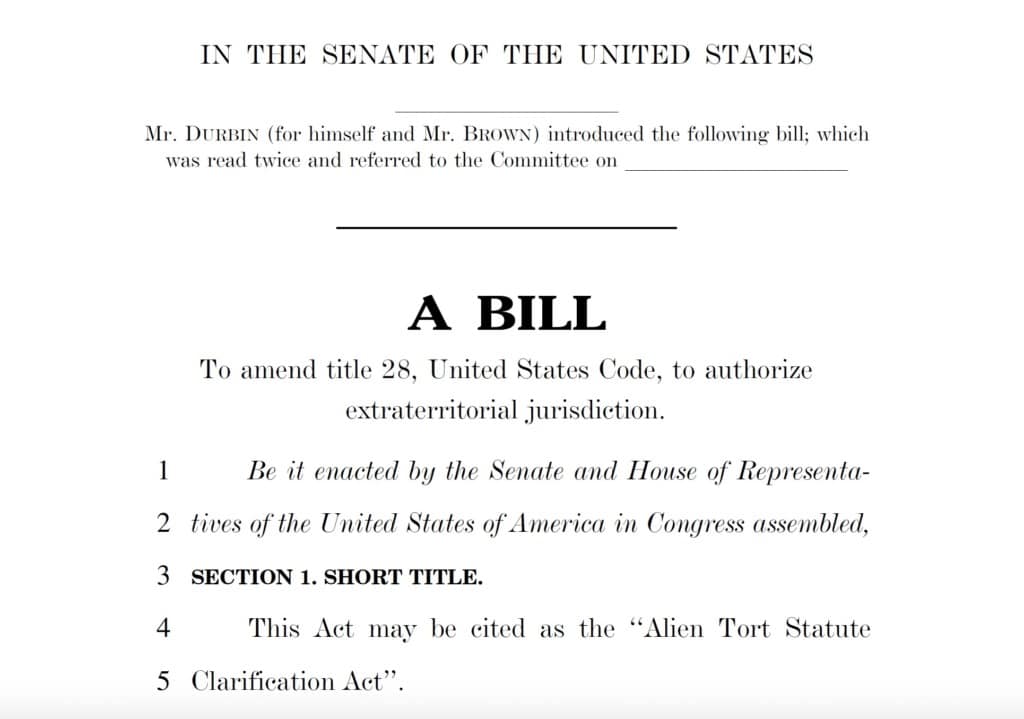
Last week, Senators Dick Durbin and Sherrod Brown introduced a new bill, the Alien Tort Statute Clarification Act (ATSCA), that would amend the Alien Tort Statute (ATS) to apply extraterritorially. Since 1980, plaintiffs have relied on the ATS to bring international human rights claims in federal court against individuals and corporations. But since 2013, the…
Continue ReadingThrowback Thursday: Joseph Story and the Comity of Nations
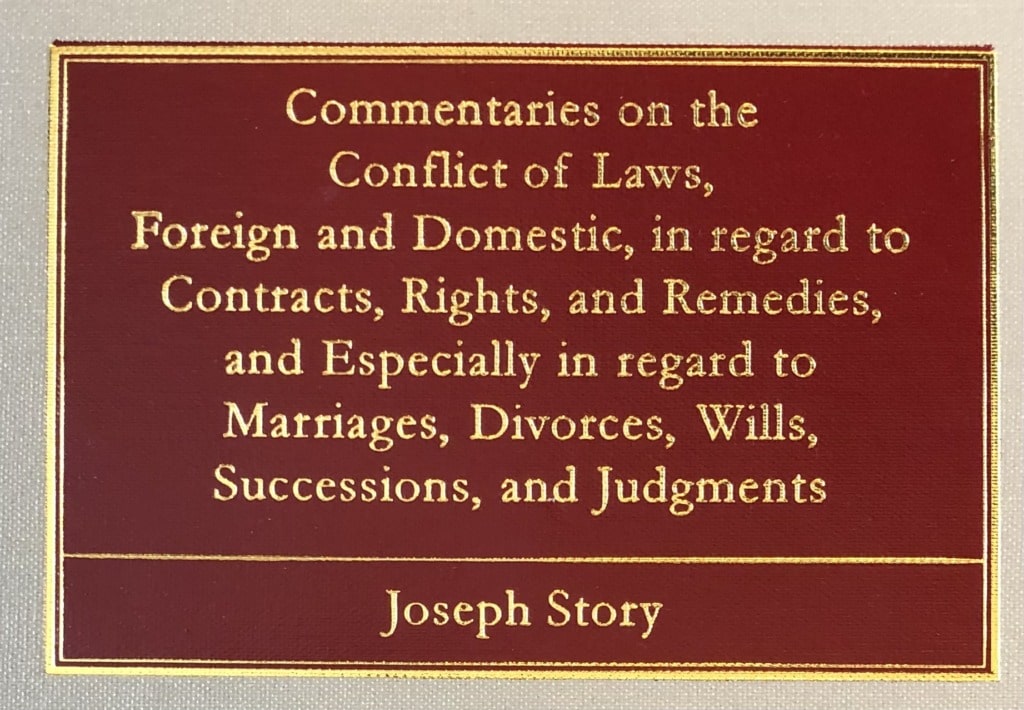
One of the most influential books on transnational litigation was written nearly two centuries ago by a sitting Justice of the U.S. Supreme Court. Joseph Story’s Commentaries on the Conflict of Laws, first published in 1834, synthesized foreign and domestic cases regarding conflict of laws and the enforcement of foreign judgments. Story endorsed international comity…
Continue Reading