
The Case for Attracting Litigation Business to the United States
U.S. state and federal courts routinely and reliably enforce “inbound” forum selection clauses (FSCs)—that is, if a party sues in a U.S. court designated by a contractual forum selection clause, courts will hear the case rather than dismissing on the basis of forum non conveniens. In a recent post, John Coyle urged federal actors to…
Continue ReadingDistrict Court Dismisses Another Case Against MBS for Lack of Personal Jurisdiction
Two weeks ago, while King Salman was appointing Crown Prince Muhammad bin Salman (MBS) as Prime Minister of Saudi Arabia in an apparent bid to secure him head-of-state immunity in a suit brought by Jamal Khashoggi’s widow, the judge in a different case quietly dismissed another plaintiff’s claims against MBS for lack of personal jurisdiction….
Continue ReadingMBS’s Appointment as Saudi Prime Minister Gives Him Head-of-State Immunity

On Tuesday, King Salman appointed Crown Prince Muhammad bin Salman (MBS) as Prime Minister of Saudi Arabia. The appointment makes MBS Saudi Arabia’s head of government, thereby entitling him to “head of state” immunity under U.S. law and customary international law. The appointment comes just days before an October 3 court deadline for the U.S….
Continue ReadingIs MBS Entitled to Head of State Immunity?

Editor’s Note: This article also appears in Just Security. In 2018, Saudi security agents brutally murdered journalist Jamal Khashoggi at Saudi Arabia’s consulate in Istanbul, Turkey. U.S. intelligence agencies concluded that Crown Prince Muhammad bin Salman (MBS) approved the operation. In 2020, Khashoggi’s widow and a non-profit organization that he helped found sued MBS and…
Continue ReadingHas the Alien Tort Statute Made a Difference?

In a globalized and interconnected world, human rights litigation has, by necessity, become transnational. For decades, the Alien Tort Statute (ATS) was viewed as a beacon of American justice for foreign victims of human rights violations. However, a series of Supreme Court decisions—most recently the paired cases of Nestlé USA, Inc. v. Doe and Cargill,…
Continue ReadingA Primer on Human Rights Litigation
Modern human rights law developed in response to the events of the World War II, although it has earlier precursors. In 1948, the U.N. General Assembly adopted the Universal Declaration of Human Rights, a non-binding declaration. More than seventy human rights treaties followed, including the Genocide Convention, the International Covenant on Civil and Political Rights,…
Continue ReadingThe ATS Clarification Act Can Protect Human Rights and Level the Playing Field for U.S. Businesses
As previously reported on TLB, Senators Durbin (D-IL) and Brown (D-OH) recently introduced the Alien Tort Statute Clarification Act (ATSCA), which, if passed, will clarify the extraterritorial reach of the Alien Tort Statute (ATS) and expand the statute’s jurisdiction to cover all defendants “present in” the United States. The ATS is one of our nation’s…
Continue ReadingCourt Holds that ATS Claims for Medical Experimentation Are Not Impermissibly Extraterritorial
In a recent decision, Estate of Alvarez v. The Johns Hopkins University, a federal district court held that claims under the Alien Tort Statute (ATS) based on nonconsensual medical experiments in Guatemala were not impermissibly extraterritorial. Although the district court ultimately granted summary judgment for the defendants on other grounds, the decision is significant because…
Continue ReadingNew Bill Would Amend the Alien Tort Statute to Apply Extraterritorially
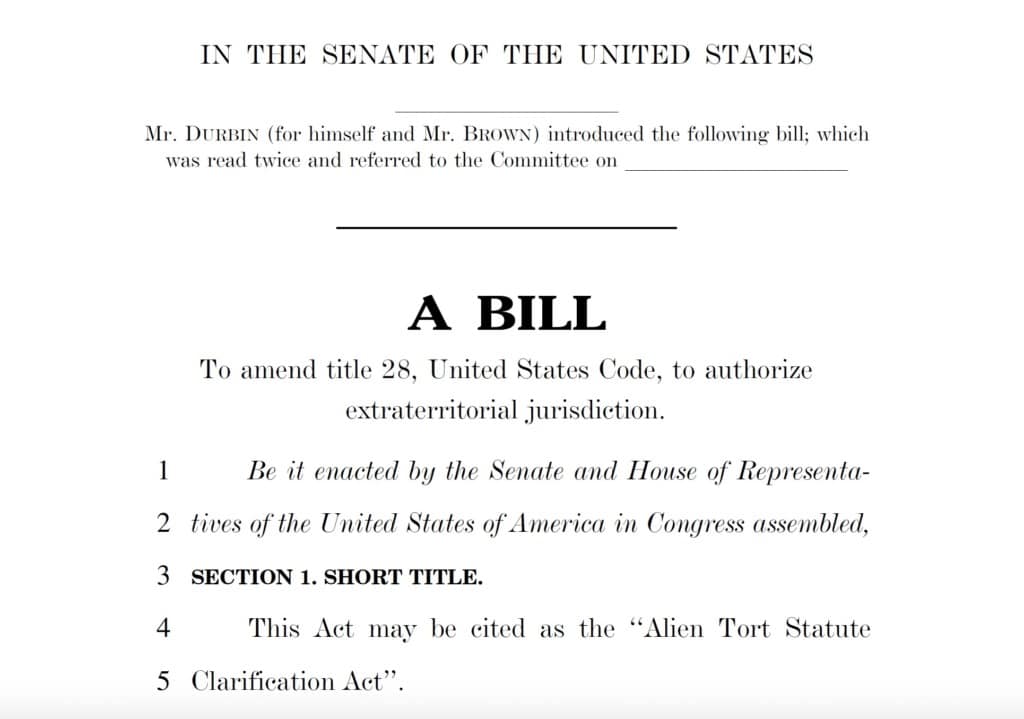
Last week, Senators Dick Durbin and Sherrod Brown introduced a new bill, the Alien Tort Statute Clarification Act (ATSCA), that would amend the Alien Tort Statute (ATS) to apply extraterritorially. Since 1980, plaintiffs have relied on the ATS to bring international human rights claims in federal court against individuals and corporations. But since 2013, the…
Continue ReadingCan Defendants Be Sued at Home? Forum Non Conveniens, Expendable Lives, and the Legacy of Gore v. U.S. Steel Corp.

Many were shocked last month when court documents revealed that Johnson & Johnson tested the safety of its talc powder in the 1960s by injecting asbestos into mostly Black inmates at Philadelphia’s Holmesburg prison. The use of Holmesburg inmates for medical studies was already well-documented, echoing the U.S. Government’s syphilis studies in hundreds of Black…
Continue Reading