
District Court Holds that Federal Destruction of Property Statute Is Not Extraterritorial
July 1, 2026
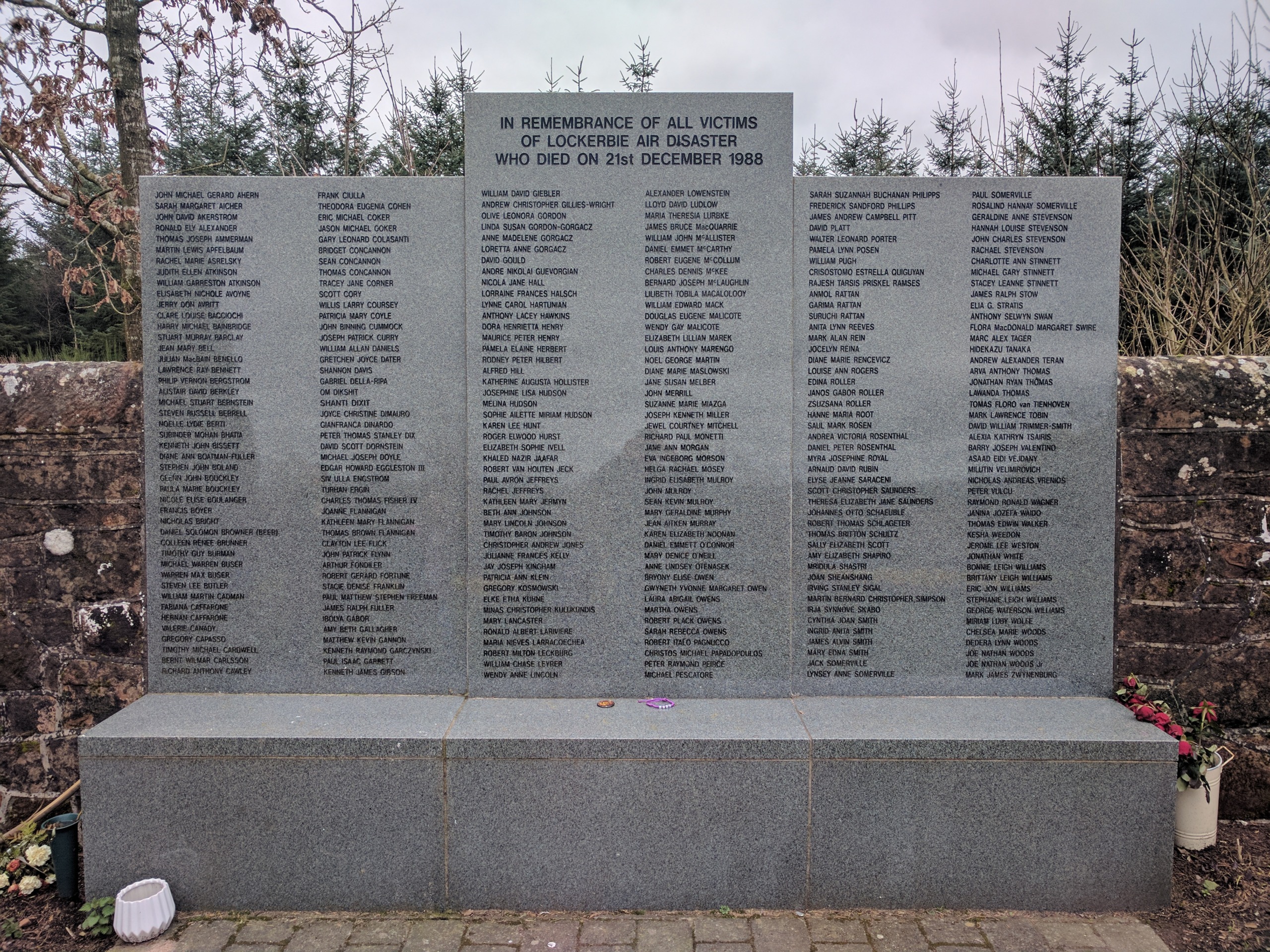
On December 21, 1988, a bomb planted onboard brought down Pam Am Flight 103 over Lockerbie, Scotland, killing 259 people on the plane and 11 more on the ground. By special agreement, two Libyan intelligence agents were tried for the bombing by a Scottish court sitting in the Netherlands. One was acquitted and the other found guilty. In 2020, the U.S. Department of Justice indicted a third person, Abu Agila Mohammad Mas’ud Kheir Al-Marimi (Mas’ud), who allegedly built the bomb. Mas’ud was apprehended in 2022.
On May 26, 2026, Judge Dabney L. Friedrich (U.S. District Court of the District of Columbia) dismissed one of the charges against Mas’ud on the ground that the federal statute criminalizing destruction of property used in interstate or foreign commerce, 18 U.S.C. § 884(i), does not apply extraterritorially. At the same time, Judge Friedrich rejected a similar challenge to charges under the federal destruction of aircraft statute, 18 U.S.C. § 32, based on Congress’s definition of “the special aircraft jurisdiction of the United States.”
Judge Friedrich’s well-reasoned opinion illustrates the difficulties that the Supreme Court’s extraterritoriality jurisprudence sometimes poses for federal prosecutions. If the Court ever chooses to reconsider its conduct-based approach, it may well do so in a criminal case.
The Presumption Against Extraterritoriality
To determine the geographic scope of federal statutes, courts apply a presumption against extraterritoriality. In RJR Nabisco v. European Community (2016), the Supreme Court articulated a “two-step framework” for applying the presumption. At step one, a court looks for a clear indication of extraterritoriality and, if it finds one, applies the statutory provision as Congress has indicated. The presumption is not a “clear statement rule,” and a court may find a clear indication in the “context” of the statute. If there is no clear indication of extraterritoriality, then at step two, a court determines whether the case involves a domestic application of the provision by asking whether “the conduct relevant to the statute’s focus occurred in the United States.”
Most recently, in Abitron Austria GmbH v. Hetronic International, Inc. (2023), the Supreme Court doubled down on the requirement of conduct in the United States. The Court emphasized that the presumption against extraterritoriality is a “presumption against application to conduct in the territory of another sovereign” (quoting Kiobel v. Royal Dutch Petroleum (2013)). The clear indication required at step one, Abitron said, must be an indication that “the provision at issue should ‘apply to foreign conduct’” (quoting Kiobel). And at step two, “to prove that a claim involves a domestic application of a statute” it is not sufficient that its focus occurred in the United States. One must also “establish that ‘the conduct relevant to the statute’s focus occurred in the United States’” (quoting Nestlé, U.S.A., Inc. v. Doe (2021); emphasis added by the Court).
The Destruction of Aircraft Statute
Judge Friedrich began with the federal destruction of aircraft statute. Section 32(a)(1) punishes anyone who destroys “any aircraft in the special aircraft jurisdiction of the United States,” while § 32(a)(2) punishes “plac[ing] a destructive device” on “any such aircraft.” The special aircraft jurisdiction of the United States is defined in 49 U.S.C. § 46501(2) to include certain “aircraft in flight,” including “a civil aircraft of the United States,” “another aircraft in the United States,” and “another aircraft outside the United States” if certain additional conditions are met.
Judge Friedrich reasoned that the disjunction between “aircraft of the United States” and “aircraft in the United States” showed that special aircraft jurisdiction “encompasses certain civil aircraft of the United States that are not in the United States, as interpreting the definitional provision otherwise would render the former subcategory superfluous.” She further noted that an aircraft outside the United States is covered if it “has its next scheduled destination or last place of departure in the United States, if the aircraft next lands in the United States” (quoting 49 U.S.C. § 46510(2)(D)(i)). These definitions, she concluded, provided clear indications of extraterritorial application.
Mas’ud argued that even if §32 reaches aircraft outside the United States, it does not follow that its provisions reach conduct outside the United States. Judge Friedrich disagreed. When an aircraft outside the United States is involved, she reasoned, the proscribed conduct would “almost certainly” occur outside U.S. borders. Thus, “the proscribed conduct itself ‘impl[ies] extraterritorial reach’” (quoting Kiobel).
The opinion did not, however, grapple with Abitron’s statement (quoted above) that a clear indication of extraterritoriality must be an indication that “the provision at issue should ‘apply to foreign conduct’” (quoting Kiobel). In fact, the opinion never mentions Abitron at all, presumably because Mas’ud’s lawyers failed to cite the case, either in their motion to dismiss or in their reply. Is a clear indication that § 32 applies to aircraft outside the United States a clear indication that it applies to conduct outside the United States? While I am sympathetic to Judge Friedrich’s conclusion, it seems in some tension with Abitron.
The Destruction of Property Statute
Mas’ud was also charged with violating 18 U.S.C. § 844(i), which prohibits destroying “by means of fire or an explosive, any building, vehicle, or other real or personal property used in interstate or foreign commerce or in any activity affecting interstate or foreign commerce.” Unlike the destruction of aircraft statute discussed above, this provision authorizes a sentence of life in prison or the death penalty if death results from the offense.
Judge Friedrich found no clear indication that § 844(i) applies extraterritorially. The provision’s reference to “foreign commerce” is not enough; as she noted, the Supreme Court has repeatedly rejected arguments that such references rebut the presumption against extraterritoriality. The government argued that none of § 844’s other subsections expressly apply extraterritorially in a way that would support a negative inference that subsection (i) does not. But, as Judge Friedrich explained, “the absence of a negative inference from surrounding provisions does not establish a positive inference suggesting extraterritorial application.” Legislative history showing that Congress intended to “protect all business property” did not, she reasoned, demonstrate an unambiguous intent “to protect all such property wherever located.”
The government also relied on the Supreme Court’s 1922 decision in United States v. Bowman, holding that the presumption against extraterritoriality does not apply to certain criminal offenses directed against the U.S. government. As I have previously explained, Bowman distinguished ordinary criminal statutes, to which the presumption does apply, from statutes that “are enacted because of the right of the government to defend itself against obstruction, or fraud wherever perpetrated.” Judge Friedrich read Bowman, and the D.C. Circuit’s applications of it, as limited to instances where: “(1) the offense directly harms the U.S. government; and (2) there is a ‘high probability that the criminalized conduct would occur abroad,’ such that ‘to limit [the statute’s] locus to the strictly territorial jurisdiction would be greatly to curtail the scope and usefulness of the statute’” (citations omitted).
Section 844(i) failed both parts of this test, Judge Friedrich concluded. First, it is not directed against offenses that harm the United States or its properties; the provision applies generally to all property used in interstate or foreign commerce. Second, there is not a high probability that conduct violating the statute would occur abroad; in fact, much conduct destroying property used in interstate or foreign commerce would likely occur in the United States. Judge Friedrich’s analysis here is clearly correct. Section 844(i) is much more similar to “[c]rimes against private individuals or their property,” to which Bowman would apply the presumption against extraterritoriality, than it is to defrauding the U.S. government, the offense to which Bowman declined to apply the presumption.
Conclusion
The Supreme Court’s recent decisions tightening the presumption against extraterritoriality have all involved civil cases in which private parties sought damages. As I have noted previously, lower courts have resisted limiting the geographic reach of criminal statutes, sometimes employing questionable reasoning to reach those results.
To her credit, Judge Friedrich did not shrink from applying to criminal statutes the presumption against extraterritoriality that the Supreme Court has articulated, dismissing one of the charges as impermissibly extraterritorial, even in a case involving a horrific act of terrorism in which 190 Americans died. Had Abitron been brought to her attention, she might have dismissed all the charges.
The problem lies not so much with the provisions of the U.S. criminal code but rather with the Supreme Court’s extraterritoriality jurisprudence and, in particular, with Abitron’s insistence on conduct in the United States. There will often be conduct outside the United States with which Congress is legitimately concerned. Planting a bomb on a commercial airliner destined for the United States certainly qualifies. It is fair to conclude that the general destruction-of-property statute does not reach cases like this one. But when Congress has specifically addressed the destruction of aircraft, and made clear that the statute applies to aircraft outside the United States, limiting the statute to conduct in the United States makes no sense. To the extent that Abitron says something different, it should be reconsidered.