
The Ferrari Is Still in the Warehouse
October 15, 2026
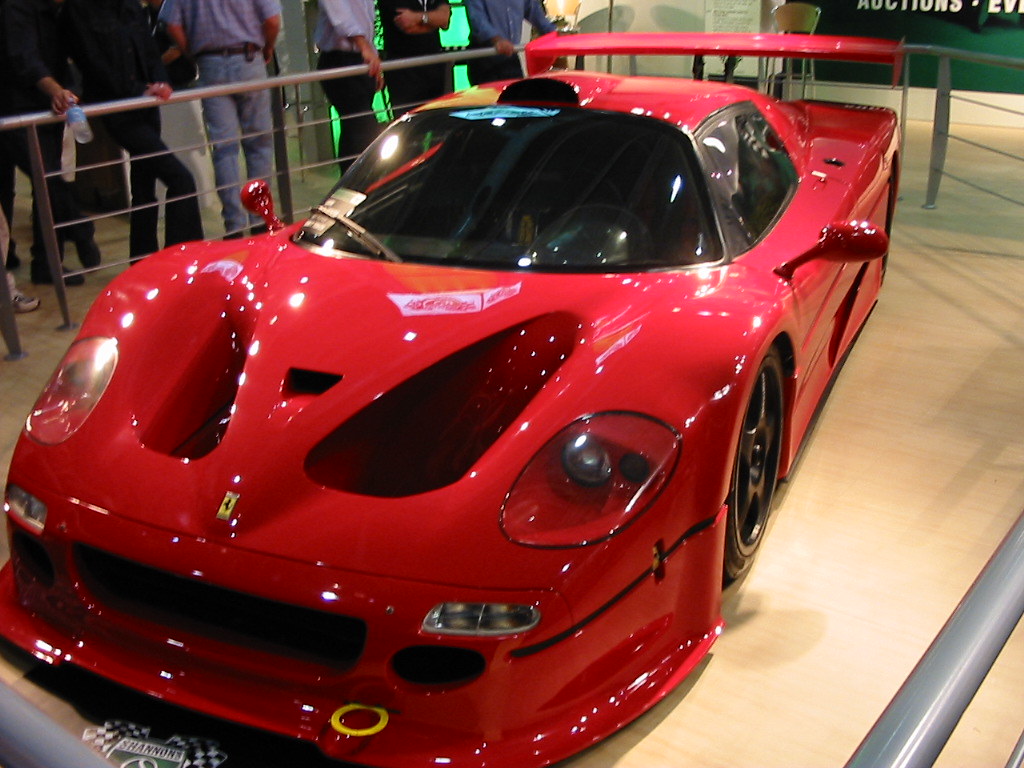
In July 2022, I authored a blog post about a Ferrari F50 that was sitting in a U.S. Customs and Border Patrol warehouse in upstate New York while a federal court tried to sort out who owned it. I recently discovered that this famed Italian supercar is still sitting in that same warehouse.
In this post, I first provide some background on the case. I then summarize everything that has happened—or not happened—to this Ferrari over the past four years.
The Backstory
The Ferrari F50 is, by all accounts, a pretty amazing car. One website describes it as the “ultimate showcase of the infamous Italian marque” and “one of the most sought-after driving machines in the world.” Only 349 were ever made. In January 2026, a Ferrari F50 sold for $12.2 million.
Our Ferrari was manufactured in Italy in 1996. In 2003, it was acquired by an Italian limited partnership consisting of Paolo Provenzi (“Provenzi”), his brother, and his father. Shortly thereafter, the car was stolen in Italy. The theft was reported to the Italian police and to Interpol. The car subsequently resurfaced in Japan, where it remained for the next sixteen years. While in Japan, the Ferrari was bought and sold several times.
In 2019, the car was sold to a company in Canada. This company, in turn, sold it to Ikonick Collection LTD (“Ikonick”), an entity controlled by Mohammed Alsaloussi. Alsaloussi arranged for the Ferrari to be imported to the United States and transported to Florida for his personal use. In inspecting the vehicle at the border crossing in Buffalo, New York, in 2020, however, the U.S. Customs and Border Patrol discovered that the Ferrari had previously been reported stolen in Italy and seized it. In early 2021, the United States filed an interpleader action and asked the court to determine who owned the Ferrari. Provenzi and Ikonick both answered and brought cross-claims against the other. Provenzi also asserted a claim against the United States.
The 2022 Decision
In July 2022, the U.S. District Court for the Western District of New York (Judge Lawrence J. Vilardo) performed a choice-of-law analysis to determine which jurisdiction’s law governed the question of ownership. Under New York choice-of-law rules, which were applicable in this federal interpleader action, the court had to determine whether New York or Italy had the “greater interest” in the litigation.
Under Italian law, an owner’s rights to property may be extinguished under a doctrine known as usucapione. The court observed that the policy underlying this doctrine is “to protect bona fide purchasers” and “promote the security of transactions within a country’s borders.” The court reasoned, however, that this policy did not extend extraterritorially. Accordingly, it held that Italy’s interest in applying its law to determine the rightful owner of the Ferrari all but vanished when the car left Italy.
Under New York law, a thief cannot pass good title. The court pointed out that Ikonick and Alsaloussi had “voluntarily associated themselves” with New York by electing to ship the Ferrari through that state. It observed that New York had a “policy of protecting owners generally.” It stated that New York “has an interest in not being a pass-through for stolen goods.” And it cited a number of New York state and federal court decisions applying New York law in cases involving stolen property. Ultimately, the court concluded that New York had a greater interest in the litigation than Italy. Accordingly, it held that New York law should be applied to determine the owner. It did not, however, actually apply New York law to resolve the question of ownership. Instead, it remanded the case to the magistrate judge with instructions to address that issue.
In my 2022 post, I expressed a number of doubts about the soundness of the district court’s choice-of-law analysis:
Viewed through the lens of jurisdictional contacts and interest analysis, the court’s analysis is not particularly persuasive. The notion that the jurisdiction through which stolen goods are being transported (New York) has a greater interest in applying its law to determine the lawful owner of the goods than (1) the jurisdiction where the goods were owned before they were stolen (Italy), (2) the jurisdiction where the stolen goods were purchased and possessed for sixteen years (Japan), (3) the jurisdiction where the goods were most recently transferred (Canada), or (4) the jurisdiction where the respective claimants are domiciled (Italy / Florida) is curious. The seizure by the CPB in New York was wholly fortuitous. The Ferrari could just as easily have been seized at a border crossing in Michigan or Vermont or Maine. This element of fortuity tends to undercut the notion that New York has a compelling interest in applying its law to resolve the dispute.
Nevertheless, if one accepts that the issue is governed by New York law, then it logically follows that Provenzi is the owner of the car. If a thief cannot pass good title, then the only person who could possibly be awarded ownership is the original owner. I was therefore puzzled when I discovered that the Ferrari was still sitting in the warehouse in October 2026. This discovery prompted me to take a look at the docket to figure out what was going.
Subsequent Events
In August 2022, the case was formally remanded to a magistrate judge (Judge Jeremiah J. McCarthy) with instructions to apply New York law to resolve the issue of ownership. The case was referred to mediation but no settlement was reached. The process of discovery then dragged on for almost a year.
In August 2023, Ikonick filed a motion requesting that the U.S. government release the vehicle to it. Provenzi opposed this motion by pointing out (not unreasonably) that the court had not yet adjudicated the question of who owned the Ferrari. In December 2023, a magistrate recommended that the motion be denied. Ikonick filed an objection to this recommendation. In March 2024, the district judge sided with the magistrate judge. The Ferrari stayed in the warehouse.
In April 2024, counsel for Ikonick and Alsaloussi resigned. Ikonick requested, and was granted, an extension of time to find a new counsel. After that deadline came and went, the court declared Ikonick to be in default. In June 2024, Provenzi moved for a default judgment against Ikonick and Alsaloussi. The magistrate judge recommended that the motion be granted with respect to Ikonick but denied with respect to Alsaloussi. In July 2024, Ikonick (after securing new counsel) objected to the magistrate’s recommendation that a default judgment be entered. In December 2024, the district court sided with Ikonick and declined to adopt the district court’s recommendation. Ikonik and Alsaloussi then requested time to obtain the file from prior counsel and review outstanding discovery issues. This request was granted.
The process of discovery formally concluded in May 2025. In June 2025, Ikonick filed a letter with the court complaining that Provenzi was refusing to hand over his copies of his key to the Ferrari for inspection by Ikonick’s expert. Provenzi pointed out that this request was not made until after discovery had formally closed. Ikonick then filed a motion asking the magistrate judge to extend the discovery period to permit an inspection. The magistrate denied this motion. Ikonick objected. In December 2025, the district court judge affirmed the magistrate judge’s decision.
In January 2026, Ikonick and Provenzi each moved for summary judgment. In May 2026, the magistrate judge recommended that Provenzi’s motion for summary judgment be granted and that Ikonick’s motion be denied. Since there is a high probability that this recommendation will finally bring this long-running case to a close, it is discussed in some detail below.
The May 2026 Recommendation
In its motion for summary judgment, Ikonick argued that Provenzi’s claim to ownership was extinguished pursuant to Italian and Japanese law long before the Ferrari ever crossed into New York. Ikonick submitted affirmations from a Japanese attorney and an Italian attorney stating that, under the laws of their countries, Provenzi had no claim to ownership. Ikonick also argued that, in applying New York law, there was no “theft” to consider because Ikonick purchased the vehicle in good faith.
The problem with these arguments, the magistrate judge reasoned, was that Ikonick “did not address [the magistrate’s] authority to reconsider [the 2022] decision regarding choice of law.” The magistrate judge pointed out that, notwithstanding years of discovery, there was no new information relevant to the prior choice-of-law analysis. In particular, there was no new evidence upon which a reasonable jury could find that the Ferrari was not stolen. The lack of any new evidence on this issue, the magistrate judge concluded, was fatal to Ikonick’s claim of ownership.
While I do not believe that the district court’s 2022 choice-of-law analysis is particularly persuasive, it is the law of the case. In light of this choice-of-law determination, and given the rule in New York that a thief cannot pass good title, the only possible outcome in this case was a judgment in favor of Provenzi. And this is precisely what occurred. The magistrate judge recommended that Provenzi’s motion for summary judgment be granted and that Provenzi be named the owner of the Ferrari.
In June 2026, Ikonick formally objected to this report and recommendation. The briefing was completed in July. The case is currently pending in the district court.
Conclusion
In transnational cases involving stolen property, it is impossible to overstate the importance of choice-of-law determinations. If the district court had concluded that the issue was governed by the laws of Italy or Japan, then Ikonick would have had a much stronger case. Once the court concluded that the issue was governed by the laws of New York, a judgment in favor of Provenzi became a foregone conclusion.
If the district court affirms the magistrate judge’s decision—a likely outcome, in my view—and if the case is then appealed to the Second Circuit, it will be interesting to see if the panel agrees with the district court’s choice-of-law analysis. If it does, then the Ferrari may finally find its back onto the open road. If not, then this long-running case could run for a while longer.