
Media Roundup: Learning Resources, Inc. v. Trump
February 20, 2026
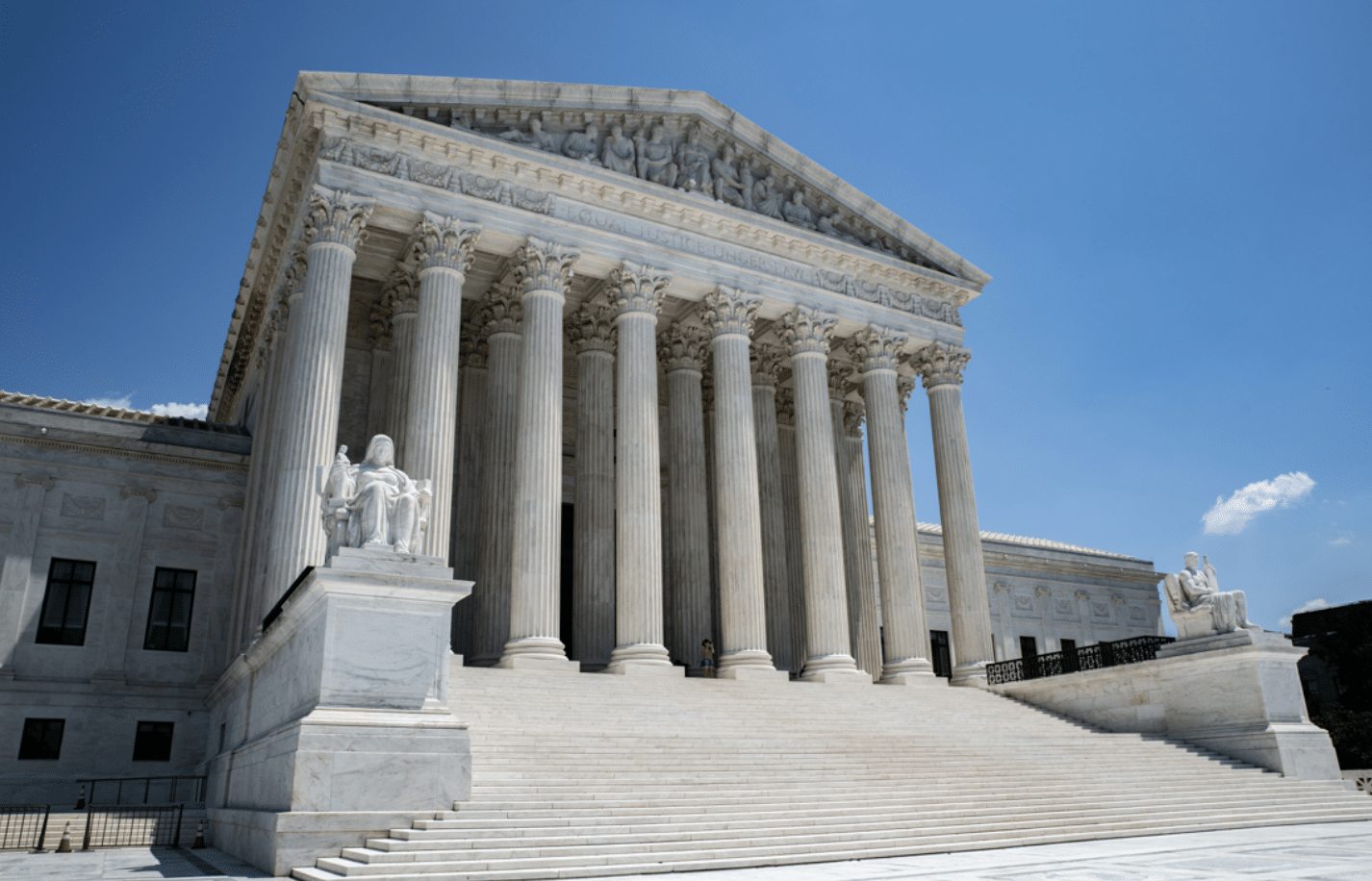
On February 20, the Supreme Court decided Learning Resources, Inc. v. Trump, a case that questioned whether the International Emergency Economic Powers Act (IEEPA) permits President Trump to impose sweeping emergency tariffs. In a 6-3 vote, the justices ruled that the tariffs exceed the powers given to the president by Congress under the 1977 law. This major ruling on presidential power did not offer any guidance on whether or how the federal government should refund the over $200 billion sum that has been collected by U.S. Customs and Border Protection.
Chief Justice Roberts’ majority opinion concluded that the words “regulate” and “importation” in the IEEPA do not confer on the President an expansive and independent power to impose tariffs on imports “from any country, of any product, at any rate, for any amount of time.” Roberts also discussed the major questions doctrine, but was only joined by Justices Gorsuch and Barrett, excluding it from the majority holding. Six separate writings followed the principal opinion.
Justice Gorsuch joined Justice Roberts in full and wrote a 46-page concurrence to further defend the major questions framework and respond to Justice Thomas’ discussion of the nondelegation doctrine. Justice Barrett’s concurrence challenged Justice Gorsuch’s framing of the major questions doctrine. Justice Kagan, joined by Justices Sotomayor and Jackson, found the ordinary tools of statutory interpretation, without the major questions doctrine analysis, were sufficient to decide this case. Justice Jackson wrote separately to rely on the legislative record and the congressional intent when the IEEPA was enacted.
Justice Kavanaugh, joined by Justices Thomas and Alito, dissented with a comprehensive defense of the government. He argued “regulate . . . importation” were not meaningfully distinguishable. As a traditional and common tool to regulate importation, Justice Kavanaugh reasoned, the President had the authority to impose tariffs. His dissent went on to argue for a foreign-affairs exception to the major questions doctrine. Thomas dissented separately to argue historical practice also supported the government’s position.
The decision has already been widely covered in the media. Here are a few of the highlights:
- SCOTUSBlog: Adam Feldman notes that while the Court resolved the question of the President’s statutory authority to impose tariffs under IEEPA, it does not resolve the refund question, set out a refund mechanism, order restitution, nor does it address the administrative process by which already paid duties may be recovered. The only explicit mention of the refunds appears in Justice Kavanaugh’s dissent where he also flags the pass through problem: whether importers who passed tariff costs to consumers can recover at all. In December, Amy Howe suggested that in leaving the remedial mechanics of refunds to future proceedings, the Court may be giving Congress time to enact a solution.
- Executive Functions: Jack Goldsmith finds that the major questions doctrine became even more muddled as a result of this case. The three conservative justices who have invoked the doctrine in various cases disagreed on how it should be used here but embraced it to rule against the President’s policy. Under Goldsmith’s view, it signals that this Court is going to view broad delegations of statutory authority to a President with skepticism in future cases.
- Bloomberg Law: Joyce Adetutu, Stephen Josey, and Jeffrey Chang previously pointed out the administration has other trade leverage in its toolkit. While the Court has ruled the use of IEEPA for sweeping tariffs unconstitutional, the administration continues to invoke other tariff authorities like Section 232 of the Trade Expansion Act of 1962 and Section 301 of the Trade Act of 1974.
- Wall Street Journal: The Editorial Board suggests the Court’s decision upholding the separation of powers was vindicated by President Trump’s response to their holding. The President labelled the six justices who voted against him as traitors and immediately invoked Section 122 of the Trade Act of 1974 to impose a 10% tariff across the board. The law expressly grants the President authority to impose a border tax of up to 15% to remedy a balance-of-payments deficit for 150 days.
- New York Times: Ann E. Marimow notes that the ruling brings a new uncertainty to global markets already struggling to adapt to the administration’s trade policies and throws into doubt a series of trade deals struck by the administration in recent months.
- TLB: In November, Anokhi Patel and Gregg Cashmark summarized the oral arguments presented to the Supreme Court, determining that the bench’s aggressive questioning suggested that the Administration would lose the case.
The implications of the Court’s decision in Learning Resources are vast. The opinion leaves open questions of refunds and the applicability of the major questions doctrine, while affirmatively constraining the power of the executive to order tariffs going forward.