
Extraterritoriality in Flux
January 21, 2026
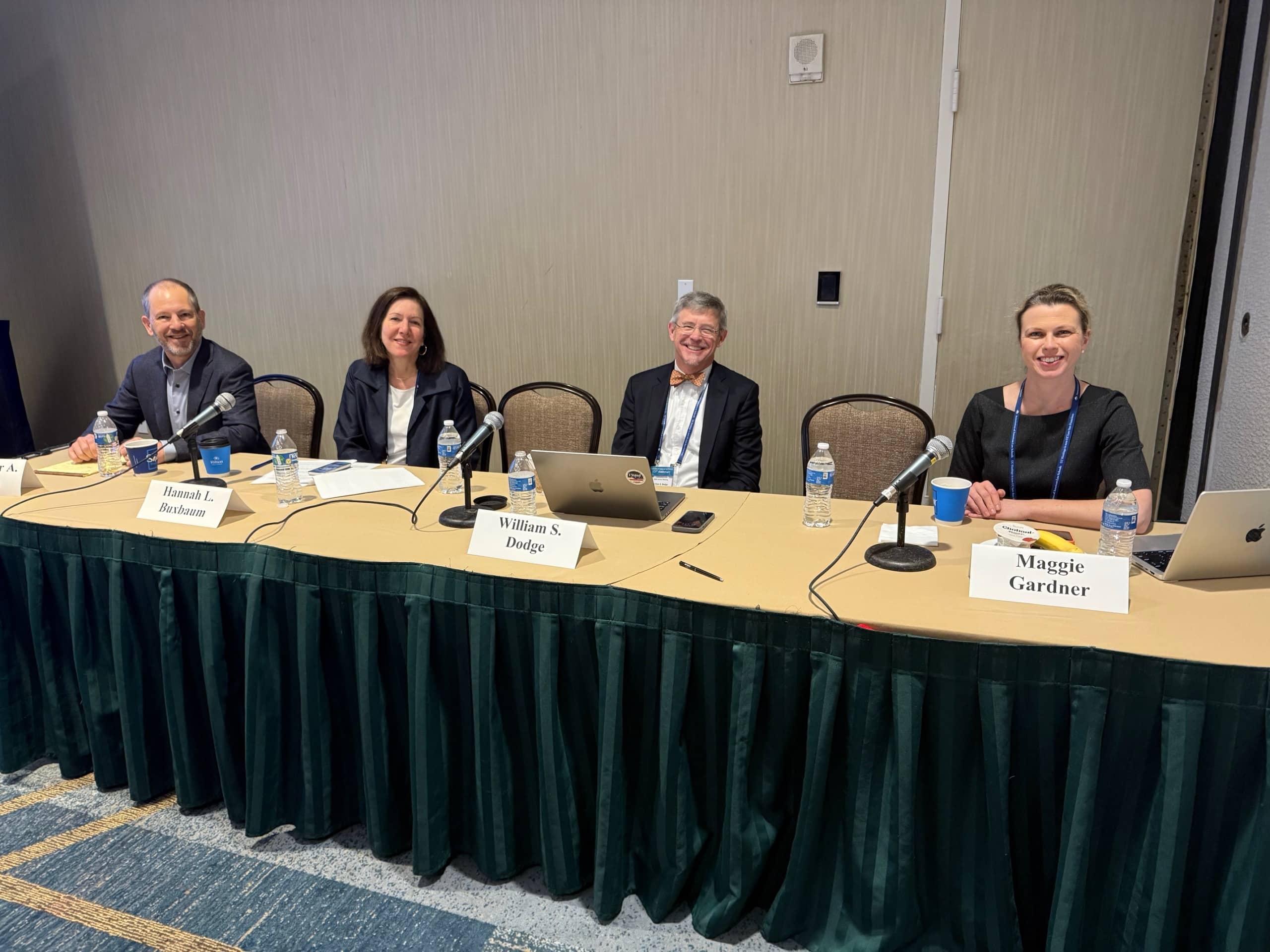
Chris Whytock (moderator), Hannah Buxbaum, Bill Dodge, and Maggie Gardner at the AALS Annual Meeting
in New Orleans, January 9, 2026
Photo by John Coyle
Earlier this month, at the annual meeting of the Association of American Law Schools, TLB Editors Maggie Gardner, Bill Dodge, and Hannah Buxbaum participated in a panel organized by the Section on Conflicts of Law entitled “Extraterritoriality in Flux.” This post summarizes their remarks.
Maggie Gardner: It’s Time to Look Beyond the Presumption Against Extraterritoriality
Maggie’s remarks focused on how U.S. federal courts handle questions of extraterritoriality. For the last fifteen years, all the attention has been on the Roberts Court’s development of the presumption against extraterritoriality. There is much that can be said about how “step two” of that analytical framework—the so-called “focus test”—is starting to collapse in on itself, with the Court unsure whether to proceed by articulating further rules (as represented by Justice Alito’s opinion for the Court in Abitron Austria v. Hetronic International (2023)) or by reverting to contextual, case-sensitive inquiries (as represented by Justice Sotomayor’s opinion for the Court in Yegiazaryan v. Smagin (2023)).
But Maggie focused her remarks on what happens when statutes do rebut the presumption against extraterritoriality—which is true of a growing category of statutes now that Congress has “gotten the memo” about how to make its extraterritorial intentions clear. That tees up a question the Roberts Court has not really answered: once a statute rebuts the presumption against extraterritoriality at “step one,” are there additional limiting principles, or do courts simply apply the statute as broadly as its language could permit? Increasingly, the lower courts are opting for the latter approach, based on dicta in RJR Nabisco v. European Community (2016) that “[t]he scope of an extraterritorial statute … turns on the limits Congress has (or has not) imposed on the statute’s foreign application.”
Maggie used the Motorola v. Hytera case from the Seventh Circuit to illustrate how broadly extraterritorial statutes may sweep under the approach. As previously covered on this blog, Hytera enticed Motorola engineers in Malaysia to leave and take Motorola’s engineering designs for two-way radios with them. It then incorporated those designs into radios sold worldwide. Motorola sued Hytera in Illinois under the Defend Trade Secrets Act (DTSA) and won an enormous jury verdict that, even after the trial judge reduced the award, still surpassed $540 million. The Seventh Circuit affirmed in relevant part even though the trade secrets portion of the award covered sales of the infringing radio worldwide, even for radios that will never enter the United States. After finding that the DTSA rebuts the presumption against extraterritoriality, the federal courts interpreted its coverage broadly: Hytera had shown its infringing radio at U.S. trade shows, and that counted as a “use in the United States in furtherance of” the global scheme. Those trade shows in the United States, then, allowed Motorola to claim damages for sales of the radio everywhere without the requirement of any additional U.S. connection. As Rochelle Dreyfuss and Linda Silberman pointed out in a prior TLB post, that puts trade secret law out of synch with other forms of IP protections—copyright, patent, and trademark—none of which allow for such worldwide damages.
This question of whether there is or should be any additional limitation on the reach of extraterritorial statutes is particularly salient when it comes to government enforcement actions, both civil and criminal. The Court has left open questions of whether statutes empowering the federal government to bring actions should be interpreted to rebut the presumption against extraterritoriality more easily; if so, that further increases the number of extraterritorial statutes with potentially unlimited geographic scope. That muscular assertion of U.S. law at the hands of the federal government will be further amplified by the Supreme Court’s loosening of personal jurisdiction requirements for federal courts in Fuld v. Palestine Liberation Organization (2025). The end result may be a federal government empowered to apply U.S. law aggressively around the world, with the federal courts lacking the ability to check excessive or abusive applications of that power.
Bill Dodge: State Extraterritoriality Is Trending Federal
Bill turned to U.S. states, which also have statutes that can reach conduct beyond their borders, whether in other U.S. states or in other countries. He started by recapitulating his findings from a fifty-state survey: most states do not have a presumption against extraterritoriality, and not all of those that do have adopted the federal framework’s two-step model. He noted, however, that more states have in recent years adopted a presumption against extraterritoriality akin to the federal model, suggesting the federal framework is exerting a gravitational pull. Importing the federal model into state law may be a mistake, however, because state statutes operate in a different ecosystem.
State statutes are subject to state choice-of-law rules, whereas federal statutes are not. Many states analyze the applicability of state statutes in two steps: first is the question of scope (does the statute reach these facts?); second is the question of priority (if multiple jurisdictions’ laws could apply to these facts, which law should govern under the forum’s choice-of-law rules?). A state’s presumption against extraterritoriality is relevant to the first step—determining scope. But even if a state statute does apply extraterritorially, choice-of-law rules may limit its application by giving priority to the law of another jurisdiction.
With that choice-of-law architecture in mind, Bill argued that state courts have been too ready to follow U.S. Supreme Court decisions—sometimes ignoring the state’s own precedents or textual differences between the state and federal statutes. His examples include a Texas Supreme Court decision that explicitly adopts the U.S. Supreme Court’s approach, a Florida appellate decision that imports federal civil-RICO holdings into Florida’s RICO statute despite differences in statutory language, and a Tennessee case invoking a presumption a presumption against extraterritoriality even though ordinary choice-of-law analysis would likely have resolved the dispute the same way.
Bill’s bottom line is simple: States do not need to have presumptions against extraterritoriality because they have choice-of-law rules. A state court may give a state statute its most natural meaning, safe in the knowledge that if another jurisdiction has a stronger claim to priority, the law of that other jurisdiction will be applied.
Hannah Buxbaum: Extraterritorial Practices Are Expanding Around the Globe
Hannah moved the conversation to the international plane. She began with an observation about the framing of the discussion so far: In most other countries, a panel on extraterritoriality would not start with the question of statutory interpretation. It would instead start with international law and its constraints on the exercise of prescriptive power.
Nevertheless, she noted, international law does not in fact significantly limit prescriptive jurisdiction today. It permits states to exercise jurisdiction when they can demonstrate a “genuine connection” with the regulated activity, allowing them quite a bit of flexibility. And in recent decades, countries around the world have increasingly embraced that flexibility, especially in the realm of economic regulation. Drawing on a comparative project that she recently completed with scholars from nearly twenty jurisdictions, Hannah sees a broad pattern: explicit extraterritorial reach is increasingly common in competition law, and it is spreading into adjacent regulatory areas such as market regulation, data protection, and consumer protection. Extraterritoriality, at least on the books, is no longer limited to a handful of dominant states.
Another driver of extraterritorial practices worldwide relates to a shift in purpose: states are expanding the geographic reach of their laws not only to protect their own domestic interests, but in the service of international or global interests. Some of that expansion is treaty-driven, particularly in the area of transnational criminal law. Multilateral frameworks addressing serious transnational crimes—think financing of terrorism, for instance—require member states to extend their domestic criminal laws to reach extraterritorial conduct.
Some of that expansion, though, is unilateral in nature, and here Hannah pointed to recent developments in the European Union. In climate and sustainability domains, the EU has been willing to extend parts of its regulatory regimes to capture foreign activity, sometimes explicitly on the premise that multilateral progress is too slow. In other words, unilateral action in the service of a global good, not just unilateral action to protect the lawmaking state’s markets.
Hannah closed by emphasizing that extraterritoriality has never been primarily a problem about law. It is at root a geopolitical problem. The growing prevalence of extraterritorial statutes does not tell us who will use them, against whom, and with what consequences. She pointed to U.S.-China dynamics and China’s explicit strategy of extending the reach of its own law to respond to perceived American overreach. A cycle of extraterritoriality to counter extraterritoriality is unlikely to end well.