
Fourth Circuit Affirms $42 Million Jury Verdict in Abu Ghraib Case
March 17, 2026
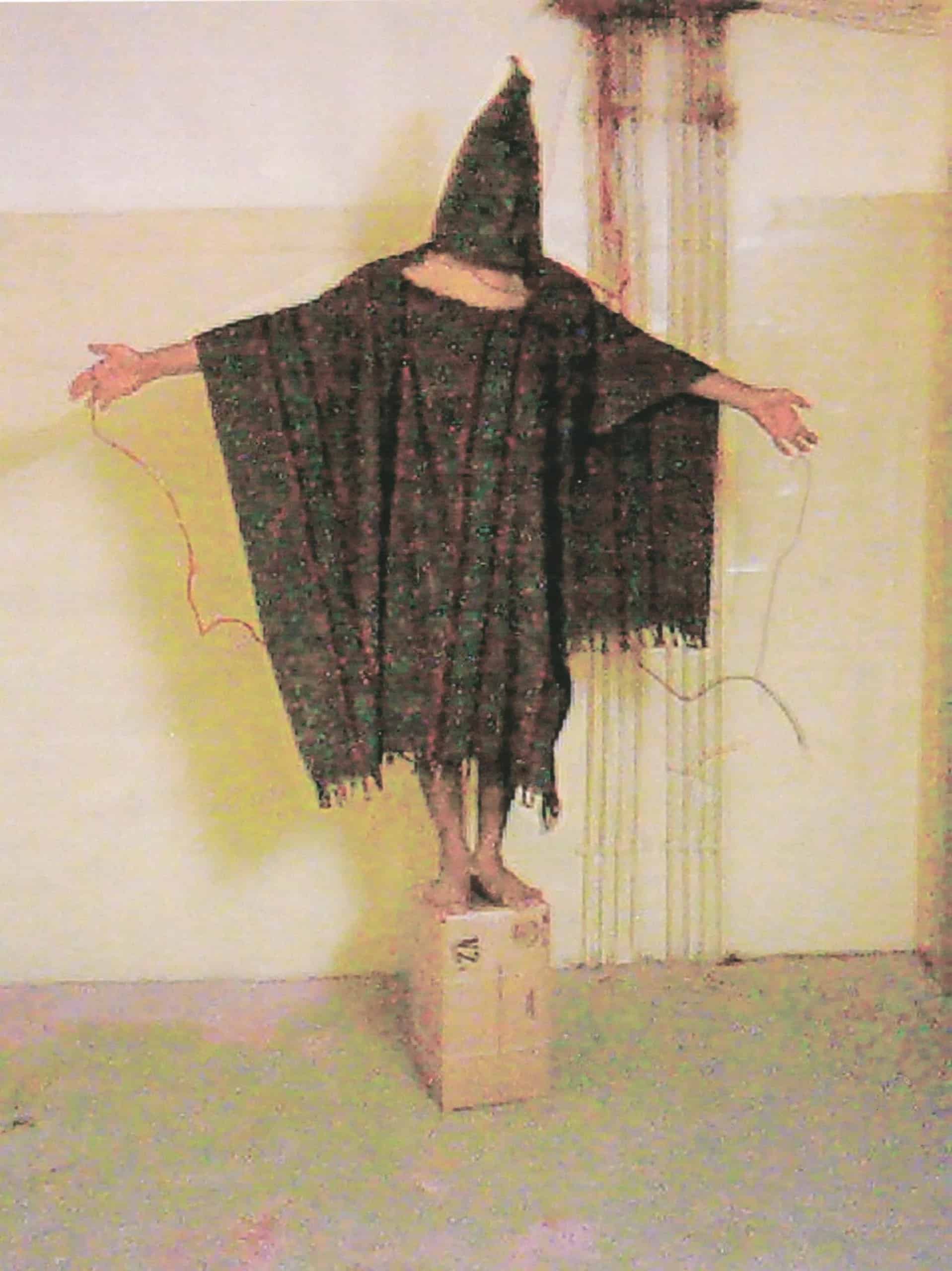
“The Hooded Man”
Public Domain
Editor’s Note: This article also appears in Just Security.
Between October and December 2003, interrogators hired by CACI Premier Technology, Inc., along with members of the U.S. military, abused detainees at Abu Ghraib prison in Iraq, subjecting them to sexual assault, forced nudity, dog threats and attacks, prolonged stress positions, and threats. In 2008, some of the detainees sued CACI in the Eastern District of Virginia, bringing 20 causes of action under the Alien Tort Statute (ATS) and state tort law.
Over 16 years and five appeals, the causes of action were winnowed to just two ATS claims: conspiracy to commit torture and conspiracy to commit cruel, inhuman, and degrading treatment (CIDT). In 2024, a jury found CACI liable on these two claims, awarding each of three plaintiffs $3 million in compensatory damages and $11 million in punitive damages. On March 12, 2026, in Al Shimari v. CACI Premier Technology, Inc., the U.S. Court of Appeals for the Fourth Circuit affirmed in a two-to-one decision.
Writing for the panel majority, Senior Judge Henry F. Floyd rejected a host of challenges to the verdict. He held that the plaintiffs’ claims were not impermissibly extraterritorial, both because the United States, rather than Iraq, exercised control over Abu Ghraib and because conduct violating international law occurred in the United States. He also held that it was appropriate to recognize claims for conspiracy to commit torture and CIDT because conspiracy is well-established in international law and holding U.S. contractors liable raised no foreign relations concerns. Judge A. Marvin Quattlebaum, Jr. dissented, disagreeing on both points.
The Fourth Circuit’s decision represents a remarkable victory for plaintiffs in a hard-fought case. But the fight may not be over. The U.S. Supreme Court has granted cert in Cisco Systems, Inc. v. Doe to decide whether aiding and abetting claims are actionable under the ATS (and another statute, the Torture Victim Protection Act, not at issue here). Although Al Shimari is distinguishable, factually and legally, what the Supreme Court decides in Cisco may well determine the ultimate outcome in Al Shimari.
Extraterritoriality
Although international law allows countries to apply their laws to conduct beyond their borders, the U.S. Supreme Court has adopted a presumption against extraterritoriality—that federal law applies only when relevant conduct occurs in the United States or Congress clearly indicates that a statute applies extraterritorially.
In Al Shimari, CACI argued that the plaintiffs’ claims were impermissibly extraterritorial because the abuses occurred in Iraq. In Kiobel v. Royal Dutch Petroleum Co. (2013), the U.S. Supreme Court applied the presumption against extraterritoriality to the ATS cause of action, and in Nestlé U.S.A., Inc. v. Doe (2021), the Court required ATS plaintiffs to establish that conduct relevant to the statute’s focus occurred in the United States. Based on the unusual facts of this case, the Fourth Circuit held that the presumption against extraterritoriality did not apply and, in the alternative, that plaintiffs had proven enough domestic conduct to satisfy Nestlé.
First, the Fourth Circuit concluded that the presumption against extraterritoriality did not apply because Abu Ghraib was within the “territorial jurisdiction” of the United States when the abuses occurred. The court relied on the Supreme Court’s decision in Rasul v. Bush (2004), holding that the presumption did not limit the application of the federal habeas statute to the Guantanamo Bay Naval Base. In Iraq, the Coalition Provisional Authority (CPA) established by the United States exercised plenary authority from May 2003 to June 2004. “Through the CPA,” Judge Floyd held, “the United States exercised equal or greater ‘complete jurisdiction and control’ over Iraq’s detention facilities, including Abu Ghraib, at the relevant time as it does at Guantanamo Bay” (quoting Rasul).
Alternatively, the Fourth Circuit held that the presumption against extraterritoriality did not apply because Abu Ghraib was not within the territorial jurisdiction of any sovereign when the abuses occurred. This made the torture at Abu Ghraib akin to piracy on the high seas, which the Supreme Court distinguished when it applied the presumption against extraterritoriality in Kiobel. “We run no risk of offending any sovereign,” Judge Floyd wrote, “by imposing the sovereign will of the United States to Iraq while the CPA was the only relevant authority in the country.”
Finally, the Fourth Circuit held that, even if the presumption against extraterritoriality did apply, plaintiffs had proved sufficient conduct in the United States to make this a domestic application of the ATS. The court addressed this question previously on appeal in 2014, applying Kiobel’s “touch and concern” test. But Nestlé abandoned that test and held that general corporate activity in the United States did not count towards domestic application. Accordingly, the Al Shimarimajority concluded:
Nestlé does not permit us to consider conduct like the domestic location of CACI’s headquarters, the domestic contract issuance, or domestic payment processing activities that we discussed in [the prior appeal] because these activities are too close to “general corporate activity.” But the remaining conduct occurring within the United States—hiring, issuance of security clearances, and attempted cover up—is still properly considered following Nestlé.
Such conduct violated the Convention Against Torture (CAT), Judge Floyd reasoned (noting in a footnote that the CAT also reflects customary international law). “[W]here the failure to implement certain controls to prevent torture is itself a violation of customary international law,” he continued, “domestic activity like hiring, issuing security clearances, and responding to alleged misconduct is directly relevant to [the ATS’s] focus.”
In short, the Fourth Circuit held that the plaintiffs’ claims were not impermissibly extraterritorial because Iraq was not exercising sovereignty over Abu Ghraib when the abuses occurred and because, even if the presumption against extraterritoriality did apply, it was satisfied by domestic conduct violating customary international law.
Recognizing a Cause of Action for Conspiracy
Whether the plaintiffs had a valid cause of action was another question. In Sosa v. Alvarez-Machain (2004), the Supreme Court authorized federal courts to recognize implied causes of action for violations of well-established human rights norms. During the 16 years between filing the original complaint and the jury’s verdict, the district court dismissed plaintiffs’ claims of direct liability for torture and CIDT and their claims of aiding and abetting. But the court allowed claims for conspiracy to commit torture and CIDT to go to the jury. On appeal, CACI argued that the district court erred in recognizing such a cause of action.
The Supreme Court has read Sosa to establish a two-part test for causes of action under the ATS: (1) whether the claim rests on a generally accepted and specifically defined norm of customary international law; and (2) whether recognizing such a claim would be a proper exercise of judicial discretion.
While several circuits have held that aiding and abetting claims meet the Sosa test, only the Eleventh Circuit has held that conspiracy claims do. Looking to the same sources on which courts have relied for aiding and abetting, the Fourth Circuit agreed that conspiracy is actionable under the ATS.
The London Charter, establishing the Nuremberg Tribunal following World War II, recognized liability under customary international law for “[l]eaders, organisers, instigators and accomplices participating in the formulation or execution of a common plan or conspiracy,” Judge Floyd noted. The Statutes for the International Criminal Tribunals for the former Yugoslavia and for Rwanda similarly provide for accomplice liability, though without specifically mentioning conspiracy. Because each of these tribunals was established to prosecute crimes that had already been committed, their statutes necessarily reflected customary international law as it existed at the time of the crimes. The CAT also recognizes liability for “complicity or participation in torture.”
More problematic was the Fourth Circuit’s reliance on the Rome Statute establishing the International Criminal Court. Although it provides liability for anyone who “contributes to the commission or attempted commission of [a crime within the court’s jurisdiction] by a group of persons acting with a common purpose,” the Rome Statute was not intended to codify customary international law. According to Ambassador David Scheffer, the lead negotiator for the United States, “relatively few” of its provisions reflect customary international law. Nevertheless, the other sources on which the Fourth Circuit relied clearly demonstrate that a prohibition against conspiracy to commit human rights violations is well-established in customary international law.
Turning to step two of the Sosa analysis, the Fourth Circuit held that recognizing a cause of action for conspiracy is a proper exercise of judicial discretion. By enacting the Torture Victim Protection Act in 1992, Judge Floyd noted, Congress expressed its “approbation of causes of action related to torture under the ATS.”
Judge Floyd also concluded that “allowing this case to proceed lacks any potential to negatively affect foreign relations.” “[T]his case does not seek accountability from any foreign government, agents thereof, or foreign citizens,” he noted. Indeed, Judge Floyd found it offensive “to proclaim that courts of the United States may not provide a remedy to foreign nationals who were tortured by members of the U.S. military as part of a conspiracy to extract intelligence using universally condemned means of interrogation.” “[T]he greatest threat to foreign relations results,” he wrote, “if this case were not permitted to proceed.”
Finally, the Fourth Circuit saw no problem with imposing liability on corporations under the ATS. In Nestlé, the court noted, “five justices of the Supreme Court agreed that ‘[n]othing in the ATS supplies corporations with special protections against suit’” (quoting Justice Gorsuch’s concurring opinion).
Other Arguments
The Fourth Circuit went on to reject other arguments that CACI raised. First, CACI argued that it was entitled to “derivative sovereign immunity” as a U.S. military contractor. Although the Fourth Circuit agreed that the United States was immune from suit—dooming CACI’s third-party complaint against the United States seeking indemnification if CACI were held liable—the court held that CACI could not benefit from such immunity because its actions were not authorized by the government. “CACI’s failure to make any argument that the specific actions at issue in this case were authorized by the government,” Judge Floyd wrote, “is fatal to its affirmative defense of derivative sovereign immunity.”
Second, CACI argued that the plaintiffs’ claims were barred by the political question doctrine because they required “inappropriate judicial review of military decisions.” The Fourth Circuit had considered the application of the political question doctrine to this case in two prior appeals. Drawing on those decisions, Judge Floyd reasoned that “[t]he crucial distinction here is whether CACI’s actions were unlawful or if they were in a grey area—although the reasonableness of military conduct may not be justiciable, the lawfulness of that conduct assuredly is” (quotation marks omitted). Thus, the jury’s finding that CACI’s conduct was unlawful foreclosed its justiciability argument.
Third, CACI argued that the Federal Tort Claims Act (FTCA) preempted plaintiffs’ claims. The D.C. Circuit held in Saleh v. Titan Corp. (2009) that the FTCA preempted state common law tort claims against military contractors at Abu Ghraib. But the Fourth Circuit held that the same preemption analysis did not apply to federal common law tort claims under the ATS. To preempt such federal claims, the court held, the FTCA would have to speak “directly” to the question, which it did not.
Fourth, CACI argued that the district court should not have reached the merits because of the “state secrets” doctrine. It was “unusual,” the Fourth Circuit noted, to apply this doctrine in a case “where trial has already occurred without the revelation of any secrets.” “The only remaining inquiry,” the court reasoned, “is whether the impact of state secrets privilege improperly prejudiced CACI in its ability to mount a defense.” In this case, state secrets had not prevented CACI from challenging whether the plaintiffs were subjected to the treatment alleged, or that CACI was involved in the treatment, or that its involvement gave rise to liability.
Finally, the Fourth Circuit rejected several defenses on the merits. It found that the admission of reports investigating the abuses at Abu Ghraib fell within an exception to the hearsay rule, that there was sufficient evidence of a conspiracy, and that there was also sufficient evidence that CACI had the power to control its employees. As for damages, the court held that the record supported the award of compensatory damages and that Virginia’s cap on punitive damages did not apply to claims under federal law.
Conclusion
The decision in Al Shimari has been a long time coming. As the Fourth Circuit noted, this was the sixth appeal in the case. Judge Floyd, who wrote the majority opinion, was on the panel for two of the prior appeals, and Judge Stephanie D. Thacker, who joined him, was on the panel for one.
One of the reasons this case has taken so long to reach judgment is that the Supreme Court keeps moving the goalposts. After the Court’s 2013 decision in Kiobel, the district court dismissed the plaintiffs’ ATS claims as impermissibly extraterritorial, only to be reversed by the Fourth Circuit which found that the claims satisfied Kiobel’s “touch and concern” test. In Nestlé, however, the Supreme Court abandoned that test, requiring the Fourth Circuit to revisit extraterritoriality in the most recent appeal.
Unfortunately, the goalposts may be about to move again. In Cisco, the Supreme Court will consider whether aiding and abetting claims can be brought under the ATS. Although the claims in Al Shimari are for conspiracy rather than aiding and abetting, they are still accessory liability claims. If Cisco rejects aiding and abetting liability under the ATS, I could easily imagine the Court vacating the Fourth Circuit and remanding for reconsideration.
The worst-case scenario would be for Cisco to overrule Sosa and limit the ATS to the eighteenth-century violations of the law of nations familiar to the first Congress—violations of safe-conducts, infringements of ambassadors’ rights, and piracy. Cisco has asked the Supreme Court to do just that, and I count four votes in favor. Such a holding would foreclose the plaintiffs’ conspiracy claims against CACI—and, indeed, all human rights claims against corporations under the ATS.