
Personal Jurisdiction in Federal Antitrust Litigation Post-Fuld: In re Diisocyanates Litigation
March 3, 2026
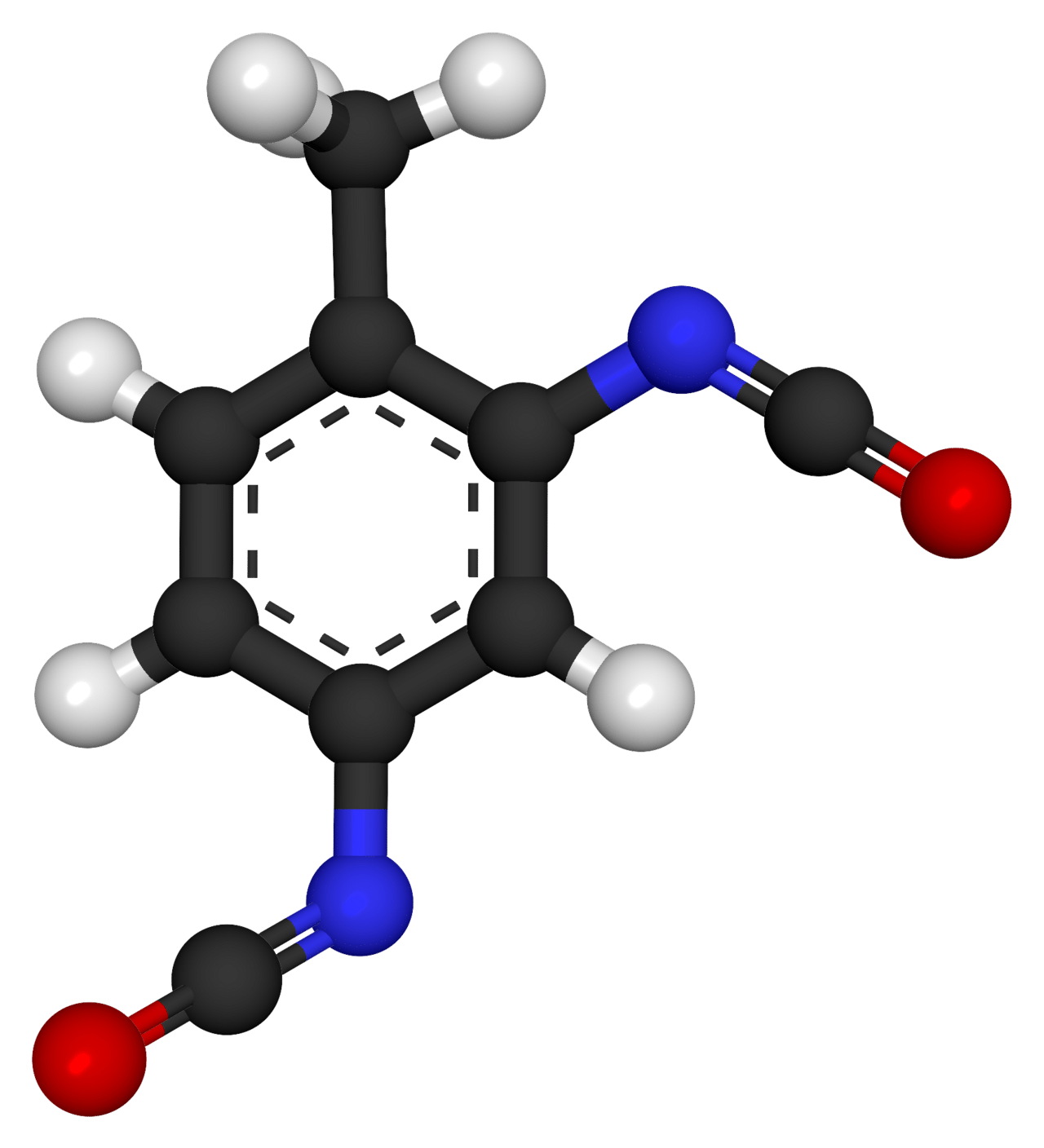
Toluene 2,4 diisocyanate model
Image by ChemSim, Creative Commons CC0 1.0 UPD
Last year, in Fuld v. Palestine Liberation Organization, the Supreme Court held that the due process limits of personal jurisdiction under the Fifth Amendment differ from those under the Fourteenth. As Maggie Gardner has noted, the Court didn’t say much about what those limits might be—meaning that the lower federal courts will now take on the task of figuring them out. In In re Diisocyanates Antitrust Litigation, the District Court for the Western District of Pennsylvania looked to some familiar frameworks: minimum contacts and purposeful availment.
Background
The jurisdictional question at issue arose in connection with multi-district antitrust litigation. The plaintiffs, U.S. manufacturers of polyurethane-based products, alleged that defendants had colluded to manipulate the global production and supply of diisocyanates, chemicals used in the production of polyurethane. Claiming that the collusion affected prices for those chemicals in the United States, they sued for violation of the Sherman Act.
Two of the defendants challenged the court’s jurisdiction over them: Covestro AG, a German company, and Wanhua Chemical Group Co., Ltd., a Chinese company. Each of these entities is at the apex of an enterprise group that includes U.S. affiliates involved in the sale of the relevant chemicals—Covestro LLC and Wanhua Chemical (America) Co., Ltd., respectively. Plaintiffs maintained that the foreign companies were subject to personal jurisdiction on two alternative bases: (1) they had established sufficient minimum contacts with the United States under the effects test for specific jurisdiction; and (2) the contacts of their U.S. affiliates could be imputed to them under theories of alter ego, agency, or co-conspiracy. (Plaintiffs also argued that these defendants were subject to general jurisdiction in the United States, clearly a losing argument under Daimler v. Bauman and one that the court properly rejected.)
Following jurisdictional discovery and supplemental briefing, Judge W. Scott Hardy issued a memorandum opinion in late January dismissing the claims against Covestro AG and Wanhua China with prejudice. He subsequently granted plaintiffs’ motion for reconsideration, and last week issued a second memorandum opinion affirming the dismissal.
Personal Jurisdiction in Federal Antitrust Litigation Post-Fuld
Section 12 of the Clayton Act authorizes nationwide service of process in claims arising under federal antitrust law. Following pre-Fuld cases analyzing due process limitations under the Fifth Amendment—applicable when a federal court exercises jurisdiction on the basis of a federal statute—the court had previously ruled that it would assess personal jurisdiction over Covestro AG and Wanhua China on the basis of their aggregate nationwide contacts.
In 2025, the Supreme Court issued its decision in Fuld. The Court there “decline[d] to import the Fourteenth Amendment minimum contacts standard into the Fifth Amendment,” reasoning that because the federal government enjoyed “broader sovereign authority” than the states, a “more flexible jurisdictional inquiry” was called for. On that basis, the plaintiffs in this case argued that the Court had “effectively overruled” the minimum contacts standard for due process inquiries under the Fifth Amendment and sought summary denial of the defendants’ motion to dismiss.
The court’s initial opinion observed that Fuld had directed lower courts to focus on the particular statutory jurisdictional grant in question, but didn’t spend much time analyzing the relevant statute. Interpreting the Clayton Act to require that the defendants be found in the United States, meaning that they must do business there, the court concluded that the nature of their contacts with the United States remained relevant. It also observed that Fuld had preserved the possibility of case-specific inquiry into the reasonableness of asserting jurisdiction. On these grounds, the court reasoned that “some showing of minimum contacts and purposeful availment with the United States remains necessary to establish personal jurisdiction in federal antitrust cases.” Having made that observation, it proceeded to analyze jurisdiction under distinctly pre-Fuld standards.
Effects-Based Jurisdiction
Neither Covestro AG nor Wanhua China had itself manufactured or sold diisocyanates in the United States. Since they had not purposefully availed themselves of the U.S. market, the court held that they had not established minimum contacts there sufficient to satisfy the “traditional” due process test. It then turned to the effects test, under which specific jurisdiction can flow from a defendant’s actions outside the forum that give rise to effects within it.
Under the effects test, a defendant’s activities must be “expressly aimed” at the forum. As the Supreme Court held in Walden v. Fiore, it is not enough that a plaintiff suffers injuries in the forum as the result of a defendant’s conduct; rather, the defendant must purposefully direct conduct toward the forum. In this case, plaintiffs argued, the defendants had “engaged in an illegal price-fixing conspiracy that was directed at, and had the intended effect of causing injury to, persons and entities” in the United States.
The court disagreed, holding that neither defendant had purposefully directed conduct at the United States. Its reasoning, though, focused not so much on where the defendants had “aimed” their conduct as on whether their conduct—as opposed to that of their U.S. affiliates—was the source of anti-competitive effects in the United States at all. The court concluded that Covestro AG was a holding company not responsible for operational functions and was thus not responsible for the supply agreements that were alleged to be anti-competitive. And only Wanhua’s U.S. affiliate, not Wanhua China, sold diisocyanates to customers in the United States (although here the court did not fully engage with plaintiffs’ argument that Wanhua China was itself involved in some of the product swap agreements at issue). In this regard, the court’s analysis of effects jurisdiction collapsed into the next part of the opinion, where it tackled the question of imputed jurisdiction.
Imputed Jurisdiction
The plaintiffs alleged three separate theories for imputing the activities of the U.S. affiliates to the defendants for jurisdictional purposes. The court rejected all three.
First, the court concluded that the plaintiffs had failed to establish that the U.S. affiliates and the foreign parent companies were alter egos. Under the entity theory of corporate law, there is a strong presumption of corporate separateness. Rebutting that presumption requires a showing of day-to-day operational control going well beyond the normal level of strategic direction and oversight characteristic of the parent-subsidiary relationship. Applying a ten-factor test on this issue, the court held that plaintiffs had failed to establish the “undue domination and control” necessary to support an alter ego determination.
Second, the court addressed the related theory of agency. If a foreign parent utilizes a U.S. subsidiary as its agent, directing it to take certain action within the United States on its behalf, those activities may be imputed to the parent as principal. Here too the court rejected the plaintiffs’ arguments, finding insufficient evidence that Covestro AG and Wanhua China directed the business activities of their U.S. subsidiaries.
Finally, the court turned to the “co-conspirator” theory of jurisdiction, under which the contacts of a resident defendant may be imputed to a non-resident defendant with whom it conspired. The court had earlier found that the plaintiffs’ complaint did not plead the foreign defendants’ involvement in the alleged conspiracy with sufficient specificity. Here it concluded that despite subsequent jurisdictional discovery, the plaintiffs had not addressed that concern. (It also noted that the Third Circuit has not expressly adopted this theory of jurisdiction.)
Comparing Jurisdiction Under the PSJVTA and the Clayton Act
Following the decision outlined above, the plaintiffs moved for reconsideration on the basis that the court had erred “in ruling that they still were required to make at least some showing of minimum contacts and purposeful availment with the United States.” In the opinion issued last week, the court provided a much more extensive analysis of Fuld’s application to jurisdiction over federal antitrust claims. That analysis involved a detailed comparison of the different statutory contexts.
The jurisdictional provisions of the Promoting Security and Justice for Victims of Terrorism Act (PSJVTA) considered in Fuld are detailed, clear, and narrowly drawn. They permit jurisdiction only over two specific entities; only in claims arising under the Anti-Terrorism Act; and only when one of two factual predicates, each involving a link with the United States, has been met. As a result, the Supreme Court explained in Fuld, the PSJVTA “ties federal jurisdiction to conduct closely related to the United States that implicates important foreign policy concerns.” The Supreme Court therefore concluded that the exercise of jurisdiction under that statute easily cleared any possible due process hurdles. What the Court did not say was that due process under the Fifth Amendment requires this level of connection to the United States—indeed, that’s precisely the question the case leaves open.
The Clayton Act is not detailed or narrowly drawn. As the district court here recognized, it is simply a long-arm statute that extends to the limits of due process. The court observed, though, that Congress had clearly expressed a “self-limit” on the question of legislative jurisdiction: under the Foreign Trade Antitrust Improvements Act, it restricted the extraterritorial reach of U.S. antitrust law to foreign conduct that “has a direct, substantial, and reasonably foreseeable effect” on the U.S. market. The court viewed this as the relevant “predicate conduct” to the exercise of personal jurisdiction in federal antitrust claims—analogous to the (express) forms of predicate conduct included in the PSJVTA. So far, so good. Then, though, the court made what I think was a misstep. It stated that jurisdiction was lacking in this case because the plaintiffs had failed to satisfy any of the “formulations actually expressed in Fuld,” such as “meaningful contacts, ties, or relations with the United States.” In other words, it assumed that establishing Fourteenth-Amendment style minimum contacts is not just sufficient but necessary to satisfy due process under the Fifth Amendment.
On my read, as noted above, the court’s real concern may have been with whether the plaintiffs had sufficiently alleged legislative jurisdiction. If I’m right about that, it would explain some slippage in the opinion between that analysis and personal jurisdiction. In one passage, for example, quoting Fuld’s statement that the PSJVTA ties the assertion of personal jurisdiction to predicate conduct that “in and of itself” bears a meaningful relationship to the United States, the court asserts that the Sherman Act ties the assertion of legislative jurisdiction to predicate conduct that “in and of itself” bears a meaningful relationship to the United States. First of all, that’s not quite right: as clarified by the FTAIA, the Sherman Act applies to any conduct that causes the requisite effects within the United States. Second, it’s important not to conflate the two types of jurisdiction (as another court grappling with Fuld recently did).
This slippage appears again toward the end of the opinion, where the court asserts that “being hailed [sic] into a foreign court to answer for purported conduct beyond the sovereign’s defined statutory reach burdens traditional notions of fair play and substantial justice.” Absolutely right: if U.S. antitrust law does not reach a foreign actor’s extraterritorial conduct, then it would indeed violate due process to assert personal jurisdiction over that actor. (Among other problems, they would not be on notice of any U.S. interest in holding them accountable for that conduct.) But here the plaintiffs alleged that the defendants’ conduct did fall within the statutory reach of U.S. antitrust law, in that their (foreign) collusive activity had caused a “direct, substantial, and reasonably foreseeable effect” in the United States. Whether or not the defendants had any other contacts with the United States related to the alleged collusion is irrelevant to the question of legislative jurisdiction—and, as outlined above, is not required, at least not by Fuld itself, to establish personal jurisdiction.
Conclusion
To borrow from choice-of-law terminology, In re Diisocyanates presents an “unprovided for” case under Fuld. The district court concluded that minimum contacts sufficient to satisfy the more restrictive Fourteenth Amendment standard were not present; however, the statutory grant of jurisdictional authority provided no specific guidance on the extent of that authority. Under those circumstances it makes sense to look—as the court did—to the geographic scope of the relevant substantive law. If that law reaches the foreign conduct of foreign defendants, there is both a U.S. interest in litigating claims arising out of that conduct and advance notice to the defendants of that interest. The question then is whether the exercise of personal jurisdiction would be “reasonable” in the particular case. In In re Diisocyanates, the court seemed to conclude that Fuld had supplied the relevant standard for reasonableness: Fourteenth Amendment-type connections with the United States of the kind present in PSJVTA claims. In my view, that is precisely the question Fuld left open.