
Using Section 337 to Combat Forced Labor Abroad
November 10, 2026
Corporate Accountability Lab
On October 28, 2026, Corporate Accountability Lab and Picard, Kentz & Rowe filed a complaint with the International Trade Commission (ITC) on behalf of two U.S. shrimpers seeking to block importation of shrimp processed by the Indian company Nekkanti Sea Foods Ltd., allegedly using forced labor. The complaint was filed under § 337 of the Tariff Act of 1930, which authorizes the ITC to exclude products made with “unfair methods of competition” that threaten to “substantially injure an industry in the United States.” Traditionally, § 337 has been used to exclude products that infringe U.S. intellectual property rights. But the complaint argues persuasively that forced labor is also an unfair method of competition.
Using § 337 to address forced labor abroad fills a gap. As I explain below, the Trafficking Victim Protection Reauthorization Act (TVPRA) prohibits forced labor and provides victims a civil remedy against perpetrators of forced labor and those who benefit from participation in a venture with them. But the TVPRA applies extraterritorially only when an alleged offender is a U.S. national, which does not seem to be true here. Other provisions of U.S. trade law may also address forced labor abroad, but they do not provide private parties with the same procedural rights as § 337.
Forced Labor in India
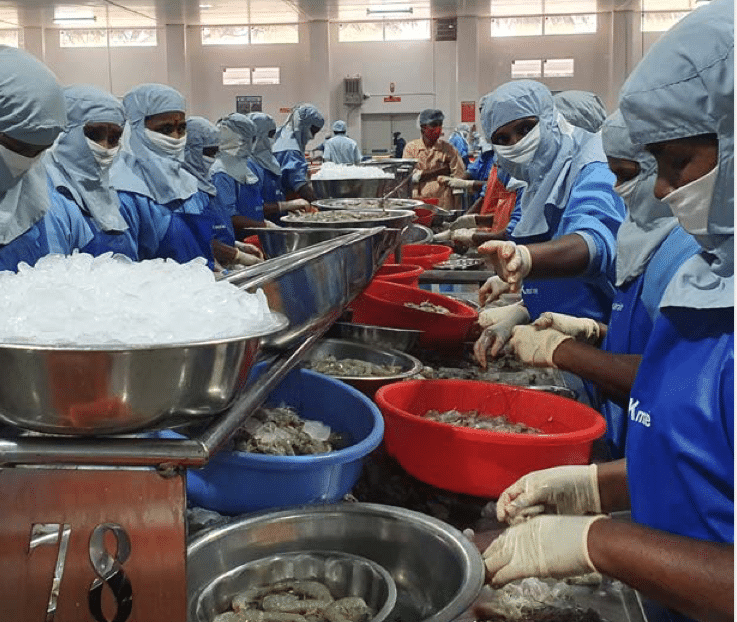
According to the complaint, migrant workers at Nekkanti’s facilities live in cramped and unsanitary conditions, which the company reportedly prohibits them from leaving. They work long hours, for less than the legal minimum wage, in dangerous conditions. Some suffer frostbite on their hands from hours peeling frozen shrimp. The complaint builds upon a 2024 report by Corporate Accountability Lab about human rights abuses in the Indian shrimp industry.
The U.S. government has also found forced labor in India’s shrimp industry. In 2024, the Department of State reported “indicators of forced labor—including failure to pay a minimum wage, restricted freedom of movement, and dangerous working conditions” as well as “debt bondage, especially among migrant workers and scheduled castes.” The Department of Labor lists “farm-raised shrimp in India” as goods produced with forced labor, noting that “[w]orkers often reside at or near the worksite in employer-provided housing—typically in a remote location—and severe security measures including lock-ins and surveillance prevent workers from freely leaving the premises.” These workers “often face intimidation and threats of termination by labor contractors, supervisors, and security guards if they fail to comply with restrictive and exploitative labor policies.”
The Limits of the TVPRA
As regular TLB readers will know, the TVPRA makes it a federal crime to provide or obtain forced labor or to benefit from forced labor. The act further provides a civil remedy for victims against perpetrators and anyone who “knowingly benefits … from participation in a venture which that person knew or should have known has engaged in [forced labor].” But the TVPRA’s provision on forced labor applies extraterritorially only when “an alleged offender” is a U.S. national, permanent resident, or otherwise present in the United States.
Nekkanti is an Indian company and is not present in the United States, so it is beyond the reach of the TVPRA’s criminal provisions and civil remedy. Other respondents in the § 337 complaint are U.S. wholesalers and grocery stores, who might be sued for benefiting from forced labor. Such benefit occurs in the United States, so plaintiffs would not have to ask a court to apply the TVPRA extraterritorially. But the TVPRA cannot be used to hold Nekkanti responsible for its labor practices or to protect U.S. companies from unfair competition.
Section 337
Section 337 can help fill the gap created by limits on the TVPRA’s geographic scope. Section 337(a)(1)(A) declares unlawful “unfair methods of competition” that threaten to “substantially injure an industry in the United States.” Although “[t]he vast majority of Section 337 claims allege patent infringement,” the plain text of the statute encompasses other kinds of unfair competition, and the ITC’s website notes that non-IP claims such as false advertising and antitrust may also be brought.
Forced labor certainly seems like an “unfair method of competition.” U.S. Customs and Border Protection’s website states that “[f]orced labor is an unfair trade practice that undermines the ability of U.S. companies to compete fairly in the global economy.” And the U.S. Trade Representative’s recent § 301 report on forced labor notes: “The United States has long recognized that it is a fundamental distortion of market principles to expect firms that source inputs and produce goods through legitimate means to compete with firms that derive a cost advantage from forced labor.” As the complaint explains, “[b]y eliminating or suppressing labor costs through the coercion of workers, Nekkanti obtains an artificial cost advantage that allows it to distort marketplace dynamics to its benefit.”
The complainants in this case are two U.S. companies that compete with imported shrimp produced by Nekkanti. Versaggi Shrimp Corporation is a family-owned shrimping business that operates five boats out of Tampa, Florida. W&W Dock LLP is another family-owned business that operates seven boats along the Texas coast. The complaint details the injury to these companies and others from competition with imported shrimp that can be sold at low prices because of forced labor. Indeed, the Department of Labor has featured Versaggi on its website as an example of unfair competition, noting that efforts to uncover unfair labor practices abroad “align with broader Trump administration actions to restore the competitiveness of American seafood producers.”
Other Trade Laws
Respondents may be expected to argue that § 307 of the Tariff Act of 1930 provides the exclusive means of excluding goods made with forced labor. Section 307 allows U.S. Customs and Border Protection to exclude goods made abroad with forced labor by issuing a Withhold Release Order. But nothing in the text of § 307 states that it is exclusive, and nothing in the text of § 337 states that it does not apply to forced labor covered by § 307. To the contrary, § 307’s prohibition on importing goods made with forced labor could be read, as the complaint argues, to establish that forced labor is, per se, an unfair method of competition.
Sections 307 and 337 are just two provisions among many that Congress has passed to address the problem of forced labor. As noted above, the TVPRA expressly addresses forced labor through criminal prohibitions and by creating a civil remedy. Additionally, the Trump administration recently concluded an investigation under § 301 of the Trade Act of 1974 of other countries’ practices with respect to the importation of goods made with forced labor. The forced labor findings have been challenged in court as “an excuse” to continue tariffs that the Supreme Court struck down as unauthorized. But there seems little doubt that § 301 covers forced labor, notwithstanding § 307.
These laws have different scopes, involve different procedures, and authorize different remedies. Getting an exclusion order under § 337 requires not only showing that forced labor is an unfair method of competition but also showing an injury to domestic industry, which § 307 does not require. Section 337 allows the ITC not only to ban imports but also to issue cease-and-desist orders to stop the sale of products that have already been imported. Section 337 also provides for a trial-like process before an administrative law judge, which is generally concluded in less than two years, in contrast to § 307 proceedings which often take longer and are more opaque.
Conclusion
The Indian shrimp complaint could open a new front in the fight against forced labor abroad. Notice of the complaint was published in the Federal Register on November 3. Public comments are due by November 12. The ITC has until December 3 to decide whether to start an investigation.