
Is Nicolás Maduro Immune from Prosecution in U.S. Courts?
April 1, 2026
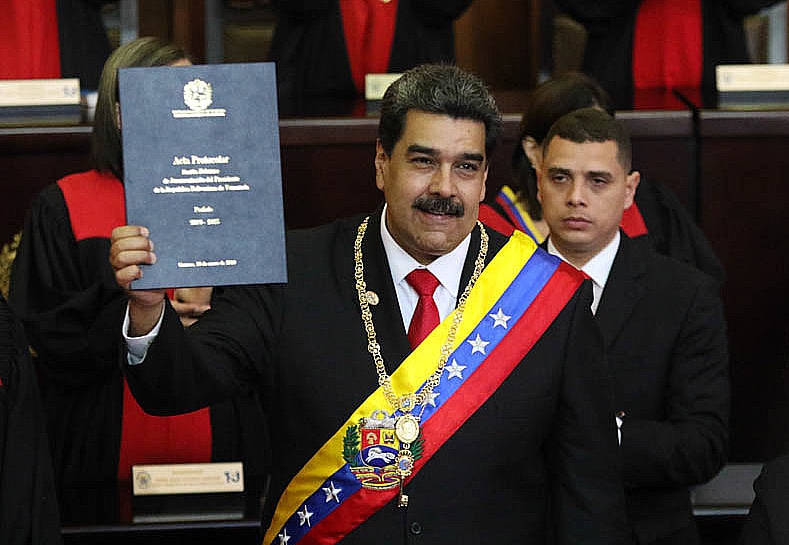
Nicolás Maduro was back in U.S. district court last week. According to news reports, the hearing focused on whether he can use Venezuelan government funds to pay his lawyers. Once that question is resolved, he is expected to raise several objections to the court’s jurisdiction to try him.
Maduro may argue that the illegality of his capture deprives the district court of jurisdiction. That challenge is certain to fail under the so-called Ker-Frisbie Doctrine discussed below. He may also argue that he is immune from prosecution as a current or former head of state, but those challenges are also likely to fail. The United States does not recognize Maduro as Venezuela’s current head of state. Former heads of state are entitled to immunity only for acts taken in their official capacities, and drug trafficking is not such an act.
The Ker-Frisbie Doctrine
There is no doubt that the United States’ seizure of Maduro on January 3, 2026, violated international law. The key question is whether that violation affects the jurisdiction of a U.S. court to try him.
The Ker-Frisbie Doctrine provides that using illegal means to bring criminal defendants to court does not affect the court’s jurisdiction. The doctrine takes its name from two U.S. Supreme Court cases. In Ker v. Illinois (1886), the Court upheld the prosecution of a person who was forcibly abducted from Peru, and in Frisbie v. Collins (1952), the Court did the same in an interstate abduction case. Most recently, the Court applied the Ker-Frisbie Doctrine in United States v. Alvarez-Machain (1992), holding that a person kidnapped from Mexico at the behest of the U.S. government could be prosecuted in U.S. court. The Supreme Court explained the rationale for the doctrine in Frisbie:
[D]ue process of law is satisfied when one present in court is convicted of crime after having been fairly apprised of the charges against him and after a fair trial in accordance with constitutional procedural safeguards. There is nothing in the Constitution that requires a court to permit a guilty person rightfully convicted to escape justice because he was brought to trial against his will.
The Ker-Frisbie Doctrine finds an international law counterpart in the principle of male captus, bene detentus (wrongly captured, properly detained). Under this principle, a state is not required to dismiss the prosecution of a defendant whose presence was acquired illegally. Thus, Israel did not violate international law by trying Adolf Eichmann for crimes against humanity, even though it did violate international law by kidnapping him from Argentina.
International practice is divided. Some states have dismissed prosecutions when the defendant’s presence was unlawfully obtained (cases are collected in Restatement (Fourth) of Foreign Relations Law § 427, Reporters’ Note 7). But even in these states, courts do not seem to have acted from a sense of legal obligation, which is necessary for their practice to count towards forming a customary international law rule.
Thus, under both international law and U.S. domestic law, the illegality of Maduro’s seizure does not affect the district court’s jurisdiction to try him.
Immunity from Prosecution
Whether Maduro is immune from prosecution under U.S. domestic law and international law is a separate question. The U.S. Supreme Court held in Samantar v. Yousuf (2010) that the Foreign Sovereign Immunities Act (FSIA) does not cover foreign officials. The Court held in Turkiye Halk Bankasi A.S. v. United States (Halkbank) (2023) that the FSIA does not cover criminal proceedings. In both situations, the Court said, common law governs immunity.
The U.S. executive branch argues that it has the authority to make immunity determination in cases not governed by the FSIA and that its determinations bind U.S. courts. The U.S. Attorney can be expected to argue that bringing a prosecution against Maduro reflects the executive’s determination that he lacks immunity.
As Ingrid Brunk and I have written, there are serious separation of powers problems with allowing the executive branch to control immunity determinations in U.S. courts. To be sure, U.S. courts must defer to the President’s decision about whom to recognize as a foreign head of state, and courts should also give significant weight to the State Department’s reasonable interpretations of international law. But, as Justice Gorsuch noted in his Halbank concurrence, “[total] deference to the Executive’s immunity decisions risks relegating courts to the status of potted plants.” In federal criminal cases, allowing the executive to control immunity is tantamount to saying that no immunity exists, for the same branch that brings the prosecution also decides whether the defendant is immune.
In Maduro’s case, however, the executive branch does not need the power to control immunity because Maduro is clearly not immune from prosecution. Two kinds of immunity are potentially relevant. Head of state immunity is a status-based immunity that protects sitting heads of state, heads of government, and ministers of foreign affairs. Conduct-based immunity applies to lower-level officials and to former officials, shielding them from liability or prosecution for acts taken in their official capacities. Neither applies to Maduro because the United States does not recognize him as a sitting head of state and because drug trafficking is not an official act.
Head of State Immunity
Head of state immunity provides sitting heads of state, heads of government, and ministers of foreign affairs with absolute immunity from civil suit and criminal prosecution, but only during their terms in office. It is based on the person’s status as holder of those offices and is recognized in both customary international law and federal common law.
Article II of the Constitution provides that the President “shall receive Ambassadors and other public Ministers.” As the Fourth Circuit noted in Yousuf v. Samantar (2012), this constitutional authority includes the power to recognize foreign heads of state. In Zivotofsky v. Kerry (2015), the Supreme Court held that the recognition power implied from the reception clause is exclusive to the President. The United States has not recognized Maduro as President of Venezuela since 2019. It is inconceivable that a U.S. court would second-guess the President’s decision that Maduro is not Venezuela’s sitting head of state.
Some have argued that Maduro is nevertheless be entitled to head of state immunity as matter of international law because customary international law does not contain a non-recognition exception to head of state immunity. Reliance is placed on a 2025 decision of the French Court of Cassation reasoning that “[t]he purpose of personal immunity … requires that it not be linked to the recognition of the status of Head of State by the forum State.” “If personal immunity were to be made conditional on recognition,” the court continued, “the result would be to confer on each State, whether democratic or not, the discretionary power to authorise criminal proceedings in its courts against a foreign Head of State.”
One might well fear that President Trump could someday derecognize Mark Carney as Prime Minister of Canada just to indict him. But it is worth emphasizing that Maduro’s case is different from this hypothetical. It is not just that the United States has declined to recognize him as head of state for seven years, through presidential administrations of two different parties. According to the U.S. State Department more than 50 other countries also do not recognize Maduro as Venezuela’s President.
If status as a head of state under customary international law does not turn on the recognition of other countries, one would need another test. Relying on a foreign country’s own determination of who is head of state begs the question of who within the country makes that determination. Certainly, Maduro considered himself Venezuela’s President, but its National Assembly declared in January 2019 that he was not. Venezuela’s interim President, Delcy Rodriguez, has stated that Maduro is “the only President of Venezuela,” but she was herself handpicked by Maduro.
In its 2022 Report on the Immunity of State Officials from Foreign Criminal Jurisdiction, the International Law Commission considered that “that the immunity from foreign criminal jurisdiction ratione personae of the Head of State is accorded exclusively to persons who actually hold that office, and that the title given to the Head of State in each State, the conditions under which he or she acquires the status of Head of State (as a sovereign or otherwise) and the individual or collegial nature of the office are irrelevant” (draft article (3), commentary (5) (emphasis added)). But this test would not help Maduro either. Even if he did actually hold the office of head of state before January 3, 2026, he certainly does not do so now.
In short, even if one rejects the notion that head of state immunity under customary international law depends on the recognition of the forum state, it would be hard to argue that Maduro is entitled to such immunity. Venezuela’s own national assembly declared that he was not President, and more than 50 countries derecognized him. His best argument may be that he actually exercised the powers of the President in Venezuela, but that is no longer true.
Conduct-Based Immunity
Conduct-based immunity applies to lower-level officials and to former officials for acts taken in their official capacities. Unlike head of state immunity, conduct-based immunity continues after the officials leave office. Conduct-based immunity is also recognized in both customary international law and federal common law.
The most recent superseding indictment alleges that Maduro was part of a conspiracy between 1999 and 2025 to traffic tons of cocaine in partnership with terrorist organizations such as the FARC. During this period, Maduro was a member of the National Assembly (2000-2006), Minister of Foreign Affairs (2006-2013), Vice President (2013), President (2013-2019), and “de-facto ruler” (2019-2025). As Minister of Foreign Affairs and President, Maduro enjoyed absolute head of state immunity (discussed above). As a former Minister of Foreign Affairs and a former President, however, he is entitled only to conduct-based immunity, which is also true with respect to the other offices he held. Conduct-based immunity applies only to acts taken in an official capacity.
The indictment charges Maduro with four counts of violating federal law: (1) narco-terrorism (which is essentially drug trafficking in partnership with terrorist organizations); (2) conspiracy to import cocaine; (3) possession of machine guns; and (4) and conspiracy to possess machine guns. The indictment alleges, for example, that, as a member of the National Assembly, Maduro transported cocaine under the protection of Venezuelan law enforcement; that, as Minister of Foreign Affairs, he provided diplomatic passports to drug traffickers; and that as President and de-facto ruler, he “allows cocaine-fueled corruption to flourish.”
One commentator has argued that Maduro is entitled to conduct-based immunity because “he allegedly abused public office and state machinery” and used “quintessentially official tools such as state protection, diplomatic documentation, and diplomatic cover for flights.” But abusing governmental authority to commit crimes does not make those crimes official acts.
It is worth noting that drug trafficking is illegal in Venezuela, making it unlikely that even Venezuela would consider it an official act. Moreover, the charges against Maduro are not meaningfully different from those against Juan Orlando Hernández, the former President of Honduras, who was also alleged to have abused his authority to facilitate drug trafficking. So far as I can tell from news reports, Hernández raised no claim of conduct-based immunity during his U.S. trial. (He was later pardoned by President Trump.)
In short, Maduro is being prosecuted for drug trafficking and related offenses. The United States alleges that he used his official positions to commit those offenses, but abuse of office does not immunize criminal conduct. Because drug trafficking is not an official act, Maduro is not entitled to conduct-based immunity.
Conclusion
I certainly agree with those who have condemned the U.S. seizure of Maduro as a violation of international law. But it is important to separate that question from the questions of whether the U.S. court has jurisdiction to try Maduro and whether he is entitled to immunity.
As I have explained, under both U.S. domestic law and international law, the wrongful seizure of a criminal defendant does not deprive a court of jurisdiction to try that defendant. Maduro is not entitled to head of state immunity because he is not a sitting head of state. And he is not entitled to conduct-based immunity because drug trafficking is not an official act.